Major Influences

In our ‘Medieval Carols’ section, it is explained how damaging the Protestant Reformation was to the carols and Mystery Plays that had hitherto enjoyed popular support in England. Both these forms of vernacular expression fizzled out during the course of the 16th century. With the dissolution of the monasteries between 1536-1541, music manuscripts were lost and the monks who had hand-copied them disappeared, so that England’s connection with European carols was broken. Although Queen Mary’s reign (1553-58) tried to reverse the English Reformation and restore Roman Catholicism, Queen Elizabeth I tilted things back to the Protestant cause.
But if things were tense in England, matters in Scotland came to a head when the reformed Kirk issued a ‘First Book of Discipline’ in 1561, which claimed that ‘the Papists have invented the feast of Christmas’ and so the Kirk simply abolished it! The ban was firmly enforced through the Kirk’s courts – for example, fourteen women were tried in the kirk session at Aberdeen in 1573 for ‘playing, dancing and singing of filthy carols on Yule Day’.1 Such enforcement seventy years before the English Parliament banned Christmas in 16472 explains why the Scots have never celebrated Christmas in the same way as the English, focusing their attentions on Hogmanay on 1st January instead.
This section will now examine some major influences that shaped our carols from the 17th century to the present time.
Catholic defiance
Two good carols emerged from catholic communities in spite of the protestant suppression of their faith. These were:
c.1654: God rest ye merry gentlemen
This was a handwritten manuscript, part of a compilation of ‘recusant’ poems. The compiler was anonymous but believed to be a member of a catholic community in the Midlands (see folk-carol entry).
1684: On Christmas Night all Christians Sing
This was compiled (maybe written) by Bishop Luke Wadding in Wexford, Ireland. As a catholic priest, Wadding had to flee Ireland to avoid persecution but returned from exile to try to rebuild trust between communities. It is a truly positive and healing carol. It is sometimes called The Sussex Carol, but that is only because the ‘standard’ tune we sing today was collected by Vaughan Williams from Horsham in Sussex. Again, see folk-carol entry.
The rise of non-conformism
Unsurprisingly, given the stresses of the English Civil War and the extreme ideology of the Puritan movement, the Church of England at the end of the 17th century found itself in a weak position. Church services were dull with little congregational singing and participation. There were lots of psalms and long sermons at Morning Prayer services. The eucharist was celebrated only rarely. The only carol that was allowed to be sung within the Church of England was While Shepherds watched, because of its Biblical words. It was at this point that the non-conformist (Congregationalist) minister Isaac Watts (b.1674) burst upon the scene. He wanted his congregations to sing and participate in services. He is credited with writing some 750 hymns,3 including the carol Joy to the World in 1719. He was followed by Charles Wesley, who wrote thousands of hymns, including in 1739 Hark how all the welkin rings, which was soon changed to Hark! the herald angels sing (see folk-carol entry). Charles and his older brother John co-founded the Methodist movement during the 1730s.4
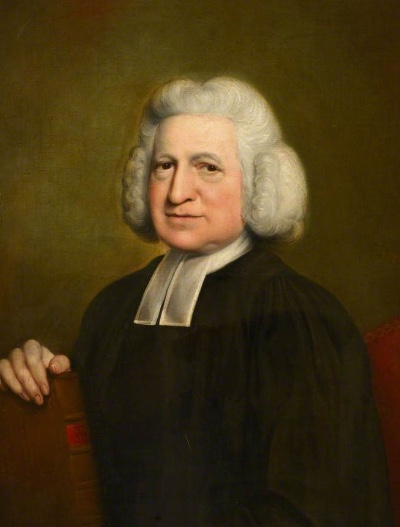
It is almost impossible to measure the extent to which the non-conformist churches stimulated the development of carols and religious music in England.5 Charles Wesley, based for twenty years in Bristol, undertook long periods of travelling on horseback and preaching in Britain, particularly in Wales, SW England and Scotland. Singing hymns was an important part of his preaching campaign among the working-class communities he visited, as they felt left out of regular church services. He first went to Cornwall6 in July 1743 and was joined by his brother John a month later – over 10,000 people gathered to hear them at Gwennap pit, near Redruth. Thousands of Cornish people became Methodists with chapels built throughout the county. In the 1851 Religious Census, 60% of people attending a religious service in Cornwall were Methodists.7
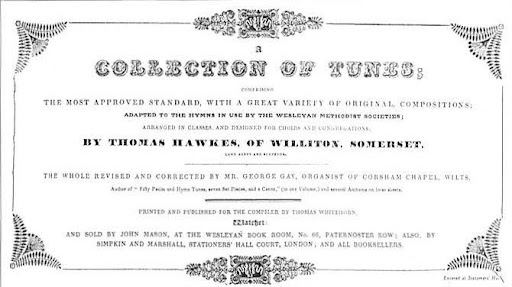
The ‘ripple effect’ of these inspiring new hymns on local music makers across the country can only be guessed at. Before long, there were publications like the Gospel Magazine8 which had essays on theological matters but also featured new hymn (and carol) tunes. The collection of tunes (illustration below) was compiled by Thomas Hawkes of Williton in Somerset in 1838 and was ‘adapted to the hymns in use by the Wesleyan Methodist Societies’.
To save money, choirs and musicians would often acquire a single music score and then copy out individual tunes and parts into precious personal books to take to practices – some of these tune books have been recovered by researchers but many were lost or forgotten. Their instruments would be purchased one at a time, as funds allowed – strings (violins, ‘cello perhaps) but also woodwind (oboe, flute, maybe even the ‘serpent’).9 All these new village musicians were proud of their playing, which earned them respect within their community. Some were confident enough to compose new tunes and arrangements – Thomas Clark, a shoemaker in Canterbury and choir leader at the Wesleyan Chapel there, composed the wonderful ‘Cranbrook’ tune10 to go with While Shepherds Watched. There was much Awaking and Arising and Saluting of the happy morn, because many carol groups went out in rural areas in the dark on Christmas morning to visit homesteads. It must have been a special and exciting time for such carolling! Carol tunes from this period have been recovered in other ‘hot spots’ like Sheffield (South Yorkshire), Dorset, Cornwall and Exmoor (West Devon), but the work is ongoing.11
Not all these new musical groups were to be found in non-conformist chapels – many parish churches hastily constructed West Galleries12 to accommodate the musicians whose role was to accompany singing the year round. The West Gallery Music Association today champions this church music.13 But several factors led to the decline of West Gallery music.
First, the initial naiveté of some musical arrangements, which naturally reflected the popularity of Handel’s14 style with fuguing passages and flourishes, became rather outdated and overly complex by the first part of the 19th century.
Secondly, most West Gallery music is in 4-part harmony, requiring some instrumental support, so rural groups would be easily disrupted by any members leaving the countryside to work in cities, as the Industrial Revolution deepened.
A third factor was a concerted move by Church of England clergymen around 1850 to aim for more polished and reliable music, purchasing harmoniums or organs and tearing down the West Galleries.15 A surpliced choir would lead singing from the chancel instead. Many of the old quire singers simply crossed the streets into the chapels or sang in the streets and pubs.16
The rediscovery of this long musical gap of a century or more after 1750 has been slow and is continuing.
‘It was essentially a grassroots movement and many of the creators of this music were from the artisan class, tradesmen such as leather workers, tailors, carpenters, and metal workers’.17
There is a (possibly sterile) debate to be had as to whether the carols of this era are genuinely ‘folk-carols’. They were certainly sung by ‘the folk’ and transmitted by ‘the folk’, but they were formally composed songs for groups in 4-part harmony in imitation of an art construction.18 One of the factors in their decline was the rise of the Oxford Movement in the 1830s and beyond.
The Oxford Movement (later called the Anglo-catholic revival)
The key leaders and founders of the Oxford Movement in 1833 were John Henry Newman, John Keble and Edward Pusey,19 who were all clerics or academics at the University of Oxford. Their goals were to restore many aspects of pre-Reformation (catholic) traditions and liturgy.20 Their impact was to generate a number of new, composed carols.
There was push-back against the initial theological or intellectual arguments of the Movement, but their influence gradually impacted church practices and cultural life more generally. In parish churches, weekly communion became more common, altars and vestments were more lavish, while the ‘Gothic Revival’ style of architecture was widely influential.21 In art, the Pre-Raphaelite painters filled their pictures with romantic themes and symbols of the Middle Ages.22 In church music, surpliced choirs appeared in ordinary parish churches and hymn books with tunes were printed in profusion.23
Individuals who were influenced by the Oxford Movement and felt inspired to write poetry and hymns, include:
Miss Cecil Frances Humphreys (1818-1895)
She was the Anglo-Irish christian who wrote the poem Once in Royal David’s City; it was one of three poems for children to help them understand parts of the Apostles’ Creed. All things bright and beautiful was to explain the phrase ‘Creator of Heaven and earth’; Once in Royal David’s City was to explain ‘Conceived by the Holy Spirit, born of the Virgin Mary’; and There is a green hill far away was to explain ‘suffered under Pontius Pilate, was crucified, dead and buried’.24 The poems were edited by John Keble and published in 1848. She married Rev William Alexander (future Bishop of Derry) in 1850 and is better known under her married name.
Rev. Edward Caswall (1814-1878)
He wrote See amid the winter’s snow in 1851. He was ordained an Anglican priest in 1839 but converted to Catholicism in 1847. He moved to Birmingham to join the Oratory community, which had been founded by Newman.
Christina Rossetti (1830-1894)
She wrote In the bleak midwinter in 1872. She was the sister of Dante Gabriel Rossetti, the Pre-Raphaelite painter. In the 1840s Christina and her mother were both attracted to anglo-catholicism and regularly attended Christ Church, Albany St in London, where Rev. William Dodsworth was the preacher. Dodsworth joined the Roman Catholic church in 1851.
Rev. John Mason Neale (1818-1866)
He wrote the lyrics of Good King Wenceslas in 1853, set to a tune borrowed from the rare Piae Cantiones book of 70 medieval songs in Latin, which was printed in 1582 AD but was forgotten until brought to England in 1853. The re-connection to the 20 medieval catholic carols therein was immediately seized upon by anglo-catholics and Neale joined forces with Rev. Thomas Helmore, an expert in Gregorian plainchant, to translate and arrange more of the songs into English including In Dulci Jubilo (translated as Good Christian men Rejoice).25 During his clerical career Neale founded the Cambridge Camden Society in 1841 to advocate for more ritual and religious decoration in churches. He was a prolific writer – The English Hymnal (1906) contained 63 of his translated hymns and 6 original hymns.
Rev. George Ratcliffe Woodward (1848-1934)
He published the song Gaudete26 in 1910 in a new edition of the original Piae Cantiones book, produced by the Plainsong and Medieval Music Society. Woodward translated the Latin ‘Puer nobis nascitur’ into English as Unto us is born a son, and added new lyrics to make Ding! Dong! Merrily on high. The last two were published in the first Cowley Carol Book (London: A.R. Mowbray, 1901, revised 1902).
The book was requested by the church of St John, Cowley, Oxford which was associated with the Society of St John the Evangelist, a new monastic order founded in 1866.
1 Hutton, Ronald, The Stations of the Sun, p26.
2 An initial Parliamentary ordinance in 1644 ordered that Christmas be treated as a normal working day – shops should open and there should be no feasting. Apprentices in London rioted. A further ordinance in 1647 made celebrations at Christmas, Easter and Whitsun a punishable offence – the ban included the singing of carols. There were more riots! The ban was not rescinded until the Restoration of King Charles II in 1660.
3 Isaac Watts’ other hymns include When I survey the Wondrous Cross and O God, our help in ages past.
4 Charles Wesley (1707-1784) wrote perhaps 6,000 sacred poems and hymns, notably Love Divine, all loves excelling and Christ the Lord is risen today.
5 Non-conformism: The Congregationalist Church (founded in 1581) and the Baptist Church (1612) were both distrustful of carols (and hymns) initially, but their policies changed during the 18th century. There was never any singing in Quakerism (The Society of Friends), which was developed in the 1650s and 1660s under George Fox.
6 Cornwall seems to have been a favourite county for the Wesleys. John Wesley visited there as late as 1773, according to the Journal he carefully kept: https://www.cornwallforever.co.uk/history/charles-and-john-wesley-visit-cornwall
7 For growth of Methodist chapels in Cornwall, visit https://cornishstory.com/2020/12/02/mapping-methodism-profiling-the-heritage-of-cornish-chapels/
8 The Gospel Magazine was established in 1766 in London; it is still produced on a bi-monthly basis today.
8 Illustration taken from Carols of the Westcountry (p.x) by the late Glyn Court, published by Westcountry Books 1996.
9 The serpent is a wind instrument invented in France in 1590; it appeared in various musical bands and ensembles in England from the mid-18th century; it became associated with West Gallery music around the same time.
10 Thomas Clark (1775-1859) wrote over 900 pieces of music. His ‘Cranbrook’ tune was composed in 1805 and was used much later for the parody song On Ilkley Moor Baht ‘at. It already had nationwide appeal.
11 Lots of local carol tunes are listed at https://www.villagecarols.org.uk/carol-indexes/index.html
12 West galleries are at the opposite end of the church to the altar and thus are behind the congregation.
13 https://www.wgma.org.uk – click ‘News and resources’ then ‘Articles’ for a fine introduction to the history.
14 George Frederic Handel arrived in London in 1710 and lived there until his death in 1759.
15 The story of the fictional Mellstock church quire is told by Thomas Hardy in Under the Greenwood Tree (1872); his short story The Absent-mindedness in a Parish Choir (1891) in his collection Wessex Tales concerns the demise of the Longpuddle quire and ends ‘…and the old players played no more’. Thomas Hardy was himself a violinist in the West Gallery at Stinsford in Dorset. His father and grandfather also played in the church quire there. Their three-generational tune books are kept at the Dorset History Centre in Dorchester.
16 Carol singing in pubs is a living tradition in the Sheffield area today.
17 Dr Ian Russell, The Sheffield Book of Carols, p2.
18 Cecil Sharp, used to interviewing individual folk singers, had the opinion that ‘these are not traditional or folk-carols but the elementary compositions of simple musicians…the melodies, if not inspired, are usually strong and sincere…’ Preface (pxii) in English Folk-Carols (1911).
19 JH Newman (1801-1890) was an Anglican priest in 1825, switched to Catholicism in 1845 and was created a cardinal in 1879. Keble (1792-1866) remained an anglican priest, as did Edward Pusey (1800-1882). All three made contributions to the Tracts for the Times publications – a series of 90 pamphlets between 1833 and 1841 which fired the movement. Followers were sometimes called ‘Tractarians’.
20 For a good overview of the Movement, try https://www.puseyhouse.org.uk/info/the-oxford-movement
21 The Gothic style of church architecture originated in the 12th century with tall pointed arches and high vertical lines; Gothic Revival architects include Pugin who designed the Houses of Parliament built between 1840-70.
22 The Pre-Raphaelite movement began in 1848, led by Dante Gabriel Rossetti, John Everett Millais and Holman Hunt.
23 The Anglican Hymns Ancient and Modern (1861) had sales of 35 million by the end of the century, but the non-conformist churches produced their own hymn books too.
24 Learning the Apostle’s Creed is part of the catechism for children and new believers, before they can receive their first communion. The Oxford Movement was keen to restore the eucharist into Anglican church practice. See https://www.hymnologyarchive.com/there-is-a-green-hill-far-away
26 Good King Wenceslas and In Dulci Jubilo were two of twelve carols published as Carols for Christmas-tide (London: Novello, 1853).
26 ‘Gaudete’ means ‘Rejoice’ in Latin. The song was a hit for Steeleye Span in 1972 (their album Below the Salt).