On Christmas Night (The Sussex Carol)


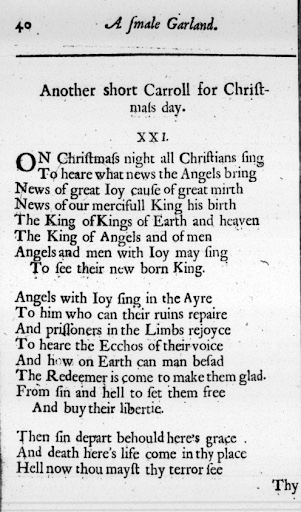
On Christmas Night all christians sing (aka The Sussex Carol) Roud 597, NOBC 139: This joyous carol has a long back story that must be told straightaway. It first appeared in a chapbook of carols and poems, compiled by the Irish catholic Bishop Luke Wadding and printed in exile abroad in Ghent in Belgium in 1684. The full title of the book is A Smale Garland of Pious and Godly Songs, composed by a devout Man, For the Solace of his Freinds (sic) and neighbours in their afflictions.1
Luke Wadding was born in 1628 in Ballycogley Castle, just outside Wexford in SE Ireland; he was the son of a wealthy merchant in a catholic but Royalist family of Old English descent. By that date many catholic families across Ireland had already had their estates confiscated by the English Crown and when the Irish Rebellion kicked off in October 1641,2 it became increasingly difficult to be a catholic and still support a protestant King.
Following the execution of King Charles I in January 1649, Oliver Cromwell took 12,000 New Model Army troops over to Dublin to re-establish English authority. In October the siege and sack of Wexford took place. Luke’s father was one of nearly 2,000 people who died; the family’s lands and business were confiscated.
Two years later Luke, aged 23, escaped into exile to Paris, where he studied at the Irish college there, becoming a priest and doctor of divinity. He was in Paris for seventeen years until 1668, when he was appointed vicar general of the diocese of Ferns (which included the town of Wexford, 16 miles to the south). He moved back into Wexford town itself in 1671 after his promotion to ‘co-adjutor bishop’ (assistant and successor).3
Reaching across to influential protestant families there, he was able to rebuild his church until a ‘popish plot’, fabricated in London by Titus Oates in 1678, triggered a new round of persecution of catholics.4 Wadding was arrested and in danger of exile again. But the storm passed and Wadding was secretly consecrated as bishop of Ferns in late 1683 or early 1684.
Out of all this terrible turmoil, therefore, Wadding compiled his healing book of poems and carols to comfort his disinherited and suppressed flock. There were 9 poems, 19 songs and 12 christmas carols (words only) in the book, which was widely distributed, being reprinted in London in 1728 and 1731. It is not certain whether Wadding actually composed most or any of these carols, but he was musical enough to be specific about the tunes that should accompany his lyrics, suggesting a number of rare or forgotten Irish tunes.5 Unfortunately Wadding did not indicate the tune to which his ‘On Christmas Night’ carol should be sung! But his joyous carol calling all Christians to join together in celebration was clearly popular at the time. Here's his original printing...
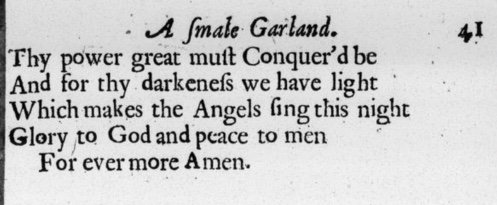
Wadding's carol would then undergo a 'folk process', featuring in broadsides (as below)
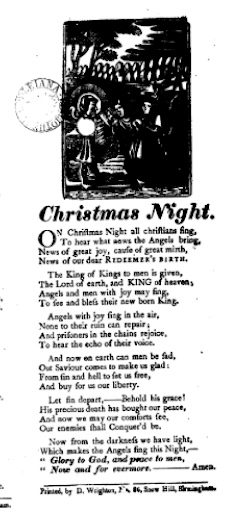
However, although this carol is listed by Hone in 1823 as one of 89 carols ‘annually printed’, it yet made no appearance at all in five of the early carol collections (Gilbert, Sandys, Sylvester, Rimbault and Husk).6 But then it was picked up by Bramley & Stainer in their third series (1878) and matched to a new tune by Essex organist Arthur Henry Brown.7
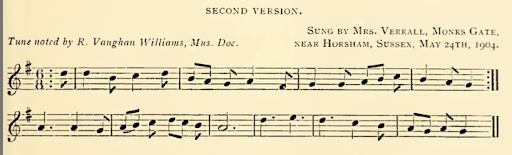
In 4/4 time, Brown’s tune was rather complex and unmemorable; and it was no surprise that when Ralph Vaughan Williams came across a lively tune in 6/8 time from 49-year old folksinger Mrs Harriet Verrall at Monk’s Gate, near Horsham in Sussex in 1904, he seized upon it and that’s the tune we sing today.8
It was the third carol that Vaughan Williams incorporated in his Fantasia on Christmas Carols for baritone, chorus and orchestra, first performed at Hereford Cathedral in 1912.9 It was the second of his Eight Traditional carols published in 1919 (Stainer & Bell), but it only attracted the new title of The Sussex Carol in the first Oxford Book of Carols in 1928.
The carol was certainly not limited to the Sussex region, however, and had a life within folk circles from early in the 19th century. There were broadsides in London and in the Birmingham area.10 Sharp collected a variant from agricultural labourer William Bayliss at Buckland in Gloucestershire in 190911 and another from Thomas Lawley in Church Stretton in Shropshire in 1923. Lucy Broadwood had previously noted a tune in 1892 from a ‘Mr Grantham, a carter’ in Holmwood village, three miles north of her home in Capel, Surrey.12
There are similarities between Grantham’s tune and Mrs Verrall’s tune (the two locations are only 12 miles apart). Broadwood suggested that both tunes might have derived from the tune Hark Hark What News in Sandys book, but this was conjecture.
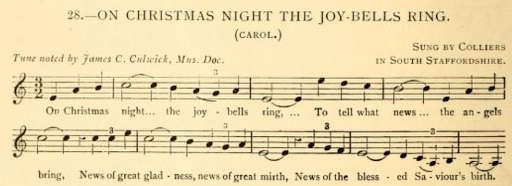
Interestingly, a further tune was noted in the 1905 Journal of the Folk Song Society (p126); this had been sent to Broadwood in 1904 by Dr James Cooksey Culwick, professor of music in Dublin. He wrote: ‘I have certainly not heard this for the past forty years. I have written it from memory of my mother’s singing.’ The first line was actually: ‘On Christmas night the joy-bells ring’, but otherwise it is the same song. Culwick noted the carol was sung by ‘Colliers in South Staffordshire’ (see below figure). Culwick’s father was a vicar choral at Lichfield cathedral and he himself was a chorister for a time there until he moved to Dublin in the 1860s, but his mother Rebecca hailed from South Staffordshire. Perhaps she was musical too and her carol tune was preserved within the family. She was born in 1816 at Coseley, just north of Dudley in the West Midlands.13 Rebecca was the daughter of a miner, John Cooksey, and no doubt as a girl Rebecca attended miners’ Christmas entertainments. This would put the date of this tune back into the 1830s at least.
Footnotes
1 On Christmas night is Carol 21 on p40, view the book online at Internet Archive platform.
2 In 1641 there were killings on both Protestant and Catholic sides. Ulster bore the brunt of the fighting and propaganda misinformation was rife, but perhaps 12,000 people lost their lives in the year that followed.
3 Information from the Dictionary of Irish Biography: https://doi.org/10.3318/dib.008830.v1
4 Oates, an Anglican clergyman, spread the rumour that Jesuits were plotting to murder King Charles II and install his catholic brother James on the throne. Irish catholics were suspected of collaborating. Priests were forced into hiding and hysterical pamphlets produced. Eventually Oates was convicted of perjury in 1685 and imprisoned.
5 Examples of tunes (in Gaelic) are: Shea veer me geh hegnough turshogh (It is lonely you have left me); Noarah Oge nee Yeorane; Neen Major Neal (daughter of Major Neale): See William H. Grattan Flood A History of Irish Music (Dublin: Browne & Nolan, 1905, pp220-221), which is viewable online at Internet Archive.
6 The carol was, however, in the chapbook A Good Christmas Box in 1847, words only, p20.
7 Brown (1830-1926) was born in Brentwood; he composed over 1,000 pieces of church music, but his tune for ‘On Christmas Night’ never caught on with the public. Whereas the broadsides split the song into 4-line stanzas for easier recall, Brown made melody for 8-line stanzas with two mannered modulations and no repeated phrases. Not folky at all, but at least it was a tune to be going on with.
8 RVW 2/2/102 at vwml, published in the Journal of the Folk-Song Society vol2 no.7 1905, p127.
9 The other two carols were The Truth sent from above and Come all you worthy gentlemen.
10 Sharp had a broadside by T. Batchelar from Moor Lane in London CJS1/10/3/593 at vwml (date pre-1832). Birmingham broadsides by T. Bloomer and D. Wrighton at Bodleian: Douce adds. 137 (22) and (58), both c1820.
11 Sharp published Baylis’s tune (in 4/4 time) in English Folk Carols in 1911 pp24,25. CJS2/10/2131 at vwml.
12 Broadwood published this tune alongside Mrs Verrall’s tune in the Journal of the Folk Song Society in 1905. Her singer was probably George Grantham, aged 74, who had lived most of his adult life in Holmwood. At his daughter Rosa’s wedding in 1894 in Brighton, George’s occupation was shown as a ‘carter’. He died in 1901.
13 Coseley is now in the Dudley Metropolitan Borough Council but in the 19th c it was in South Staffordshire. Rebecca Cooksey was baptised at Coseley Baptist church on 10 January 1831 but was born on 15 January 1816. She died in 1893. Her son Dr Culwick Mus. Doc., FRCO, was born in Lichfield in 1845 and died in Dublin in 1907.