Broadsides

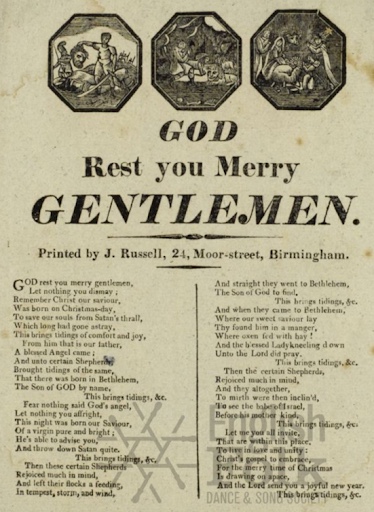
Although folk-carols, like all folk songs, might be transmitted ‘by ear’ – just hearing another singer or perhaps a family member singing them – transmission through printed ‘broadsides’ and other cheap print media was also important. Broadsides were commercially produced single sheets, sold for a penny by street vendors or hawkers at market fairs, from local shops and door-to-door by pedlars. Initially concentrated in London, Dublin and Edinburgh, by the 19th century there were printers at many provincial towns.
They were called ‘broadsides’ because they were printed on the broad side of the printing press (in today’s terminology: ‘landscape’ format, rather than ‘portrait’) and then cut up. Sometimes a large sheet was printed and then folded into 8, 12, 16 or 24 small pages, which could be simply stitched together to form ‘chapbooks’. These might contain short stories, fairy tales, religious tracts or folk songs – collections of songs were sometimes called ‘Garlands’. Chapbooks were designed to fit snugly into waistcoat pockets and were sold on the streets by ‘chapmen’.
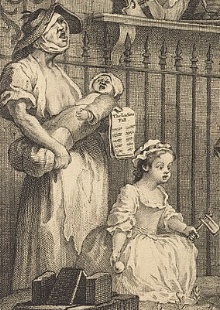
Ballad-seller from Hogarth’s engraving
‘The Enraged Musician’, 1741:
New York, Metropolitan Museum
(public domain)
The early broadsides (roughly 1550-1700 AD) used heavy Gothic typeface and were called ‘blackletter’ broadsides.1 Laws, royal decrees, religious texts, moral warnings, news of executions, crimes, disasters, ‘monstrous births’ were published in the same format, but ballad verses were extremely popular, although very few were carols.2 But early in the 18th century printers changed over to plainer Roman type ('white-letter'), which was clearer and easier to read. Woodcut illustrations were often used and re-used at the top of song and carol sheets. Printers like John Pitts3 in London began producing large-format Christmas carol sheets from around 1820 (multiple carols, decorated with imposing woodcut motifs). Colour printing was not possible, but you could buy hand-coloured versions for twice the price.
The Edwardian folksong collectors acquired their own sets of broadsides to check the development of carol texts (and songs generally). This enabled them to patch up or ‘correct’ any inadequacies of memory shown by particular singers they might encounter.4
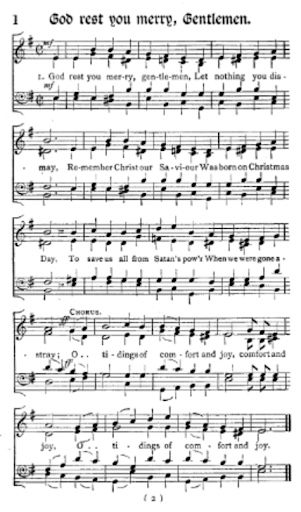
Broadside printing was cheap because they were ‘words only’, no tunes. The process of ‘scoring’ or incising musical notes 5 and staves onto metal plates was laborious and expensive - some of the early carol books were printed with only limited numbers of tunes (melody only).6 Technology jumped forward in 1847 when the publisher Alfred Novello used a newly designed moveable metal type for musical notes and staves.7 This could produce a cheaper, multi-part score and subsequent carol books benefited greatly from this innovation.8 After this development, broadside ‘words only’ printing naturally began to fade.
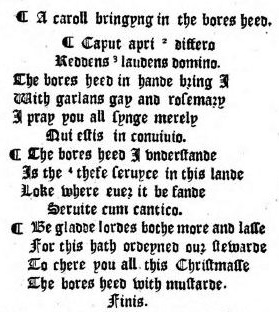
The Boar’s Head (Bore’s heed) carol was printed in 1521
in blackletter type as part of a quarto booklet of Christmasse Carolles by Wynkyn de Worde, an apprentice of William Caxton.
The original is held at the Bodleian Library (Rawlinson MS).
Sources and reference books:
There are many libraries with broadsides in their collections, too many to mention here, but two online libraries can be recommended:
- Bodleian Library, Oxford:
- EBBA: English Broadside Ballad Archive at the University of California Santa Barbara.
Good reference books include:
Shepard, Leslie, The History of Street Literature (Newton Abbot: David & Charles, 1962)
Ed. John Payne Collier, Broadside Black-Letter Ballads (first printed 1868, new edition by British Library, 2011)
Eds. David Atkinson and Steve Roud, Street Ballads in Nineteenth Century Britain, Ireland and North America (Routledge, 2014).
1The EBBA website includes images of nearly all the surviving examples of blackletter song sheets.
2Samuel Pepys, however, collected a broadside of The Cherry Tree Carol, dated c.1686 (see the entry in ’12 folk-carols’). Pepys collected roughly 1,800 blackletter broadsides, which he donated in his will to his old college Magdalene College, Cambridge.
3John Pitts (1765-1844) began printing in 1799 at 6 Great St Andrew St, Seven Dials (now 33 Monmouth St) in London. Search https://www.britishmuseum.org for examples of Pitts’ work (including coloured sheets).
4Best examples are at Vaughan Williams Memorial Library: https://www.efdss.org/vwml where Cecil Sharp’s carol broadsides are at CJS1/10/2/425-450 and Lucy Broadwood’s at LEB/9/390.
5See Bibliography in ‘Sources’ section – Gilbert’s carol book only had 9 tunes and Sandys’ book only 13.
6This is the origin of the term ‘music score’. The metals used were copper, pewter or zinc.
7The choral series that Novello began to print were called ‘Novello’s Octavo Editions’ and they met the pent-up demand of newly-forming Choral Societies.
8The three series of carol books by Bramley & Stainer, produced between 1867 and 1878, presented 70 carols, all with tunes and many arranged for SATB. The books were designed for congregational use and went through several editions, dominating the public space. They were printed by Novello.
I am grateful to Steve Roud for his advice on this section