Medieval Carols

In late medieval times the word ‘carol’1 meant a song-dance. These song-dances were widespread across Europe – the French used their word ‘carole’ and we copied it. Holding hands, a ring of people would sing and do a circle dance.2 Their leader would sing the verses and the dancers joined in the chorus, which was always called the ‘burden’. The music required a specific structure, rhythm and metre (most often 8-syllable lines) to fit the stepping.3
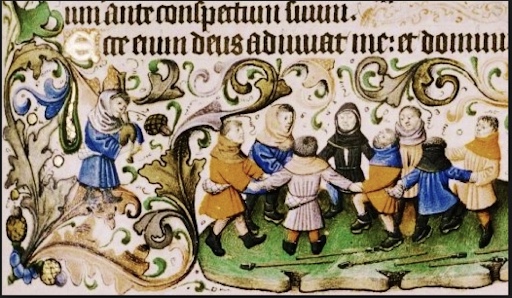
Our early carols were written in Middle English and had a variety of themes – carols for Easter or celebration of Springtime,4 convivial ‘good ale’ carols, amorous songs and lullabies as well as the Nativity story. The American scholar Richard Leighton Greene in his book The Early English Carols presented 474 medieval carols, of which 212 (45%) were about the Nativity and/or the Virgin Mary.5 Very few of today’s carols can claim direct lineage back as far as these early carols - possible exceptions would be The Joys of Mary 6 and The Holly and the Ivy,7 both of which directly echo medieval concepts and motifs.
One development that would significantly influence our early carols was the arrival in England of Franciscan monks in 1224. Within sixteen years they had recruited over 1,000 new monks nationwide. St Francis of Assisi had founded his new order in 1210, based on rules of simplicity and poverty. He re-created the first live Nativity scene (animals, crib, Mary and baby Jesus) in Greccio, Italy in 1223. Thereafter the figure of the Virgin Mary became a softer, central focus of much sacred music and poetry.
Before the ‘carol’ form came along, the catholic Church had sponsored anthems and hymns to sing at the various Christmas services and masses. These hymns were in Latin and mainly in the Gregorian plainchant style. The first 20 songs in the New Oxford Book of Carols are this type of Latin hymn, including no.16: ‘Veni, veni, Emanuel’ (O Come, O come, Emanuel) which was not translated and published in England until 1851.8
Note: After the Norman Conquest, the language of the royal court was Old French,9 so when the people began to sing ‘carols’ in their own Middle English language, it must have felt liberating. Equally liberating would have been the dramatic pageants (in vernacular dialect) known as Mystery Plays. These had been regularly performed across medieval Europe, but the earliest record in England is 1376 AD (the York Mystery Play). The Coventry Carol 10 (Lully, lulla, thow littel tyne child) is one of only two carols to survive from the Mystery Play texts.
As regards the tunes to accompany our medieval carols, few manuscripts with musical notation have survived. The Trinity Roll manuscripts at Cambridge University and the Selden manuscripts at the Bodleian Library, however, give us rare music notations of nine 15th century carols (New Oxford Book of Carols nos. 27-35). These are simply stunning to view 600 years later, and thanks are due to the Bodleian Library particularly for releasing them to public view.11
The ‘carol’ song-dance form lasted for over 200 years here in England, between roughly 1300 and 1520 AD and there can be no doubt that the coming Protestant break with Rome under Henry VIII did irreparable damage to our early carols. The dissolution of the monasteries (1536-1541) deprived people not only of many manuscripts but also of the monks that used to copy and preserve them. The Protestant denunciation of the doctrine of Corpus Christi (the real body and blood of Jesus in the eucharist) around 1568 led to the collapse of the Mystery Plays too within a decade.12
In conclusion, ‘carols’ subsequently became simply songs sung especially at Christmas – the loose definition we use today, but even as late as 1892 John Julian in his Dictionary of Hymnology13 was happy to define a ‘carol’ as a ‘song of joy originally accompanying a dance’.
1 The etymology of the Old French word ‘carole’ is still debated but the probable root is Greek khoros (chorus/dance). The Old French word was borrowed into Middle English as ‘carol’.
2 Ring-dances are, of course, features of many cultures and over centuries of time, but they are usually passed on informally rather than written down.
3 The use of 8 syllable lines is technically called Trochaic metre – 4 trochee units per line. Example in a Shakespearean verse is: ‘Double, Double, toil and trouble’ (Macbeth).
4 Shakespeare used the word ‘carol’ to refer to a Spring song in As You Like it Act 5 sc3 (c1599): ‘This carol they began that hour…how that life was but a flower in the springtime…’. Chaucer had written (c1370) in the Book of the Duchesse lines 848-9: ‘I saw hir daunce so comlily, carole and synge so swetely’.
5 Greene, Richard Leighton, The Early English carols (London: OUP 1935). Greene (1904-1985) was Professor of English at the University of Rochester New York and a pioneer scholar in the research of early carols. His book is viewable online at Internet Archive.
6 There are 6 different manuscript versions of the Five Joys of Mary carol, dated 15th or 16th centuries – three are held at Balliol College, Oxford. They are laid out in Greene pp163-166. At this early stage of the carol, Mary had 5 Joys - The Annunciation, The Birth of Jesus, His Resurrection, His Ascension, The Assumption of Mary herself into Heaven. For theological reasons, these Joys were changed in later ‘folk’ versions.
7 There are 4 ‘Holly and Ivy’ carols in Greene (pp93-95); they refer to pagan symbolism rather than Christian messages, however.
8 The Rev. JM Neale did the translation of 'Veni, veni, Emanuel', matching the text with an old French tune (New Oxford Book of Carols p45.)
9 The first monarch with English as his native tongue was Henry IV, who took the throne in 1399.
10 The Coventry Carol is no.40 in The New Oxford Book of Carols (see Composed Carols section of this website).
11 Carol 33 in the New Oxford Book of Carols is ‘Nowel: Out of your sleep aryse’, a 15th century carol from the Bodleian Library (MS.Arch.Selden.B.26 folio 14v). Text and music viewable at www.medieval.bodleian.ox.ac.uk https://digital.bodleian.ox.ac.uk/objects/11d9f36c-2e48-47d3-b7a3-a9decd76fd28/surfaces/a38e8aa4-7cb2-4e04-a740-34953ae11846/
12 The last Mystery Play performance took place at Chester in 1578. The Mystery Plays were always staged on the Feast of Corpus Christi, sixty days after Easter, in the summertime.
13 Julian, John, Dictionary of Hymnology (London: John Murray, 1892 p205).