Joys of Mary, The (Seven)


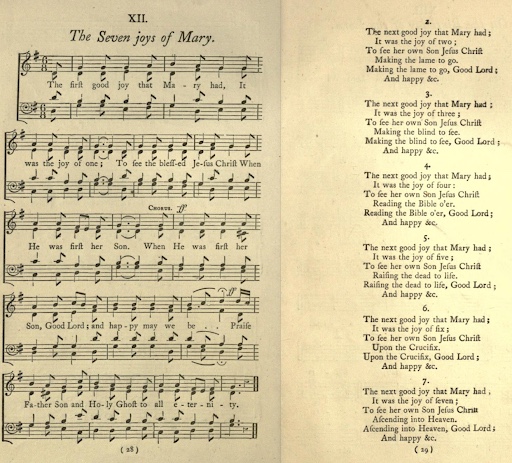
The (Seven) Joys of Mary: Roud 278: NOBC 131: This carol was very popular in England in the 19th century, appearing regularly in single sheet broadsides in the first decades of the century1 and then later in the special Christmas issues which featured multiple carols and (sometimes coloured) illustrations.2 The earliest record of the song is, however, in 1764 in the catalogue of the London printers Dicey and Marshall.3 There are versions still current today in both USA and Ireland, but it’s fair to say that this has become rather a specialist carol, not widely sung today in England.4
Although the carol looks to be of relatively modern construction with a ‘traditional tune’ added by Bramley & Stainer in 1871,5 this carol has deeper medieval roots with a few textual phrases being retained over centuries. A late medieval carol (15th century), described FIVE Joys that the Virgin Mary experiences – the Annunciation by Archangel Gabriel; the birth of her son Jesus; his Resurrection; his Ascension; and her own Assumption into heaven.6 The Sloane manuscript (MS2593) at the British Museum begins the story:7
(v1). The ferste joye, as I you telle
With Mary met Seynt Gabrielle
‘Heyl, Mary, I grete the well
With Fader and Sone and Holy Gost.’
The Second Joy in verse 2 has the birth ‘on Crystemesse Day’; the Third Joy is ‘when he rose fro ded to lyf’; the Fourth Joy when he is ‘in hevene in ryche aray’; and finally, the Fifth Joy is when ‘in hevene he crownyd his moder (mother)’. This is simple doctrinal instruction by song,8 but one that would not survive the protestant downgrading of the catholic church’s veneration of the Virgin Mary – at least not in this format.
The first textual element to go was the burden (or chorus) that went with this dance-song, which ran: ‘I may synge of a may (maiden) Of joyis five and merthis most’. The Annunciation and Assumption elements were also cut, but the song was then actually expanded to (at least) SEVEN Joys, drawing on Jesus’s miracles in rather simplistic terms to achieve rhyming effect:
‘…the joy of two to make the lame to go;
the joy of three to make the blind to see’ and so on.
It became a ‘number’ song to challenge children’s memory at Sunday School, no doubt.
When Cecil Sharp collected a version in Somerset in 1908 from Eliza Duddridge, she sang him Ten Joys, which included ‘bring the crooked straight’ to rhyme with ‘eight’ and ‘turn water into wine’ to rhyme with ‘nine’. She was 62 and said she had learned if from her grandfather, which takes her song back into the 18th century.9 Sharp published it in his English Folk-Carols but in 4/4 time rather than the bouncy 6/8 time of Stainer.
However, the interesting thing about many of the 19th century broadsides is that they resurrected the idea of a chorus, whereby the last line of each joy (miracle) was repeated thus:
(Joy of two) to make the lame to go;
To make the lame to go, good man,
How happy may you be,
O Father, Son, and Holy Ghost
And Christ to eternity.
This hark back to the last line of each verse of the medieval carol (see above) is perhaps true testament to folk memory and imagination.
Footnotes
1 ‘The Seven Joys of Mary’ at Bodleian Library: Douce adds. 137 p19 (T. Bloomer) and p61 (D.Wrighton), both printers in Birmingham c1820. Sharp cited broadsides by J.Evans and G.Thompson in London: CJS1/10/3/591,592 at vwml.
2 For example of colour illustration, see Lucy Broadwood’s collection at vwml: J.Catnach ‘The Evergreen’ sheet at LEB/9/392/5. No date. The patent for chromolithography (overprinting of several colours) was taken out in 1837.
3 Roud, Steve and Bishop, Julia The New Penguin Book of English Folk Songs (London 2012 p510). Messrs Cluer Dicey and Richard Marshall were printers at Bow Churchyard in London. The only extant copy of their 1764 catalogue is held at the University of Glasgow Library, but online notes at the Oxford Text Archive at the Bodleian.
4 See various performances at https://mainlynorfolk.info/wyndham-read/songs/thesevenjoysofmary.html
5 John Stainer did not acquaint us with the source of his ‘traditional tune’ but the first two phrases do curiously resemble the nursery rhyme tune ‘Three Little Kittens’, which first appeared as a poem by American poet Eliza Follen in 1827, then with a tune in RM Ballantyne’s illustrated storybook Three Little Kittens (Boston 1858 pp30-31): see Internet archive. But this similarity of tune is rather speculative.
6 The doctrine that Mary was taken into heaven dates from the 6th century, possibly earlier. The Feast of the Assumption is celebrated by catholics on 15th August.
7 This is Carol 231 in Greene (p164) and is also quoted in Rickert p205. Sandys in 1833 cited this carol (p58) as well as offering the standard broadside version of the day (p157).
8 For discussion of these catholic church’s devotional practices to Mary, see The New Oxford Book of Carols pp462-3
9 Eliza Duddridge lived at Mark village, nr Bridgwater: see CJS2/10/1805 at vwml and English Folk-Carols pp33-35.