Holly and the Ivy, The


The Holly and the Ivy: Roud 514: NOBC 126: This is an odd carol for a few reasons - first it was never sung in church nor yet was it widely adopted in vernacular singing - there seem to be no ‘West Gallery’ nor local traditions surviving from the 18th century. Yet in 1823 William Hone lists it among the carols ‘annually printed’ and there are two broadsides in the 1820s in Birmingham.1 William Husk wrote as late as 1864:
This carol appears to have nearly escaped the notice of collectors, as it has been reprinted by one alone, who states his copy to have been taken from “an old broadside, printed a century and a half since,” i.e. about 1710. It is still retained on the broadsheets printed at Birmingham. It is possible that it is an ancient carol.2
What we have is a carol with an uncertain pedigree perhaps but with a very consistent text throughout the 19th century – and if Husk is correct, the 18th century too. Bloomer’s broadside c.1820 is pretty much what we sing today. The first verse ‘The Holly and the Ivy/Now are both well grown/Of all the trees that are in the wood/The holly bears the crown’, is followed by the usual chorus ‘The rising of the sun/The running of the deer/The playing of the merry organ/Sweet singing in the choir’. Then we have the usual elements – the holly bears a blossom, berry, prickle, bark etc. But what we do not have is a tune to keep the carol high in popularity. We simply do not know how people sang this song.
The second oddity about the carol is its strange mix of pagan symbolism and Christian theology. Several ideas are at play here – for centuries holly and ivy have been among the evergreen plants used to decorate houses in the winter to symbolise enduring life and the hoped-for return of spring. But holly was also seen as a protective plant and a masculine plant. Ivy was viewed as a feminine plant. There are several medieval carols that pit the holly and ivy in contention to be masters of the house – in some the holly is dominant, but the ivy has her qualities too:
Nay, nay, Ive, it may not be, iwis,
For Holy must haue the mastry,
as the maner is.3(No, no, Ivy, it may not be indeed,
For Holly must have mastery,
as the manner is.)Ivy, chefe off treis it is;
Veni coronaberis…
Ivy beryth berys black;
God graunt us all his blisse,
For there shall we nothyng lack;
Veni, coronaberis.4(Ivy, chief of trees it is;
Come, you shall be crowned …
Ivy bears berries black;
God grant us all his bliss,
For there shall we nothing lack;
Come, you shall be crowned.)
We can see here already the subtle shift whereby the poet begins to associate plant elements (berries) with religious power, even if the berries are from the ivy. In today’s carol, the holly is fully ascribed to Jesus: berry=his red blood; prickle=his crown of thorns etc. Equally the Virgin Mary (representing Ivy) is fully included, so the male/female balance is maintained.
The final oddity in the carol is the chorus itself with running deer and merry organs, which do not seem to match the sentiments of the verses at all. Keyte and Parrott, editors of the New Oxford Book of Carols are convinced that the chorus is a later interpolation, describing it as ‘incoherent and oddly irrelevant…the present first verse is surely the proper refrain’.5
The absence of a good tune for The Holly and the Ivy remained a problem, even after Edward Rimbault, organist and musicologist, took it upon himself to graft an ‘old French’ tune onto the text in 1863 - this was the first tune it ever received ‘officially’. It’s a dull tune in D minor and, although embraced by Bramley & Stainer (see below) in 1871 and by Chope in 1875, it perhaps never secured popular favour.
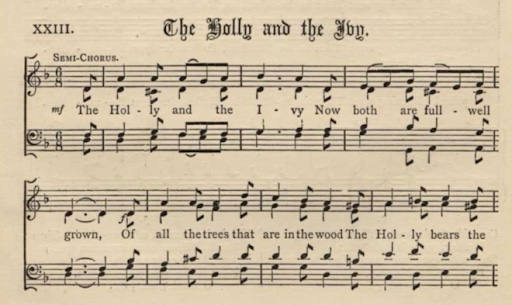
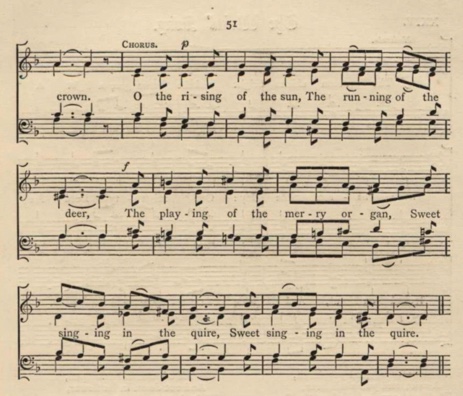
In 1909 Cecil Sharp then stumbled upon a much brighter tune from Mrs Mary Ann Clayton of Chipping Campden, Glos and this is the standard tune we sing today:6
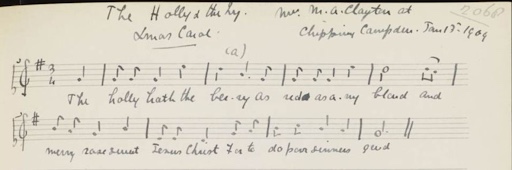
Sharp collected seven variants in all - from Camborne in Cornwall in 1913 to Ross in Herefordshire in 1921. The Camborne tunes by Mrs Hezeltine and Mrs Oliver strangely do not show any association with the Cornish Sans Day variant that we now know,7 which was collected in the early 1900s by Mr W.D.Watson, the head gardener of the Borough of Penzance, from a Thomas Beard in the village of St Day, 2 miles east of Redruth. It was collected in the Cornish language, which may have limited its spread. Watson had learned Cornish from his mother and, as a keen folklorist himself, passed the song to Rev. Canon Gilbert Doble, vicar of Wendron, who had it published in translation in The Oxford Book of Carols in 1928.8 The Sans Day carol has similar sentiments to The Holly and the Ivy, the first verse being:
‘Now the holly bears a berry as white as the milk
And Mary bore Jesus, who was wrapped up in silk.’
But then it omits running deer and merry organs altogether, substituting:
And Mary bore Jesus Christ, our Saviour for to be
And the first tree in the greenwood, it was the holly (x2)
It is noteworthy that neither Davies Gilbert nor William Sandys, both champions of Cornish song, were able to find the Sans Day carol for their publications in 1823 and 1833. Perhaps it was still in embryonic form.
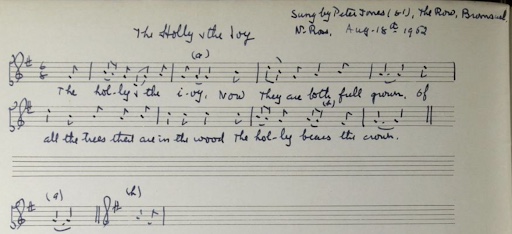
A final hurrah must be accorded to one more version of The Holly and the Ivy carol recorded as late as 1952 by Maud Karpeles and Pat Shuldham-Shaw from 81-year old Peter Jones, agricultural labourer, at Bromsash near Ross-on-Wye, Herefordshire (see below). This tune is now widely sung in folk circles – a well-known video, taken at The Royal Hotel in Dungworth, near Sheffield in 2008, shows singers using this Herefordshire tune.
Footnotes
1 T. Bloomer: Douce adds. 137 (25) 1817-27; D. Wrighton of Snow-hill: Douce adds. 137 (63) at the Bodleian Lib.
2 Husk Songs of the Nativity (London: JC Hotten, p85). Husk’s broadside quote is actually taken directly from Joshua Sylvester’s A Garland of Christmas Carols book 1861 (Sylvester was a pseudonym, possibly for Husk himself). Husk replicates the carol in full but words only.
3 16th century carol, cited by Greene, no.136 p94 from MS 354 at Balliol College, Oxford.
4 15th century carol, cited by Greene, no.138 p95 from Bodleian Lib MS Eng. Poet. e. 1. ‘Coronaberis’ is from Latin verb ‘coronare’: the Feast of the Assumption of the Virgin Mary was celebrated on 15 August in catholic England.
5 New Oxford Book of Carols p437.
6 Sharp published Mrs Clayton’s tune in English Folk-Carols (London, Novello p17), it is CJS2/10/2068 at vwml.
7 For Mrs Hezeltine, CJS2/10/2823 and Mrs Oliver CJS2/10/2845 at vwml. They derive from Rimbault’s tune.
8 The first Oxford Book of Carols p41. It was also published in Ralph Dunstan’s The Cornish Song Book in 1929. See also John Speller’s Web pages at www.archive.org. In the New Oxford Book of Carols the Sans Day carol is no.127.