While Shepherds Watched


While Shepherds watched their flocks by night: Roud 936, NOBC 46, English Hymnal 30: This carol was accepted into the English Hymnal by its editor Vaughan Williams in 1906 and its text has rarely been altered – 6 verses of 4 lines in strict metrical rhythm (8 syllables, 6, 8 and 6).1 The text of ‘While Shepherds watched’ was composed by the Anglo-Irish poet Nahum Tate2 and published by him in 1700.3
It was a re-phrasing of St Luke’s story of the Nativity (chapter 2, verses 8-15) and, as biblical words, the poem could be adopted by the Church of England without controversy.4 Here is the original format entitled ‘Song of the Angels, at the Nativity of our Blessed Saviour’:
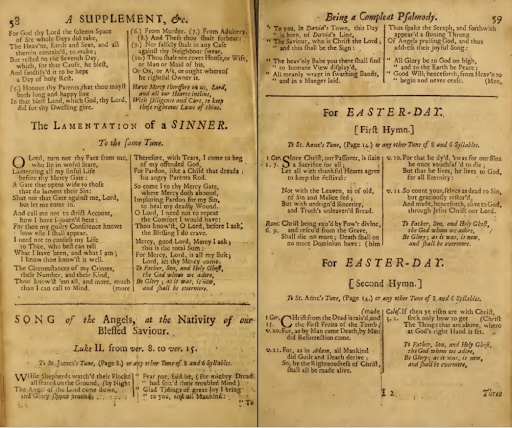
You can see (above) that the tune recommended was St James’ tune, which had recently been composed by Raphael Courtville, first organist of St James’ church, Westminster in 1697. Unfortunately, that tune didn’t work well and other tunes were tried. Effectively it was subjected to the ‘folk process’, which is why it can be included here as a ‘folk-carol’.
There are in fact over 100 tunes for this carol, many anonymously composed over two centuries for village bands and carollers right across the country. Many were four-part arrangements for choirs rather than songs for individual folk-singers. There are, for example, 8 tunes in The Sheffield Book of Village Carols as published by the late Dr Ian Russell.5 In Padstow in Cornwall the well-known ‘Zadoc’ tune is sung each year,6 and there are many other examples7(including several in America).
Thus ‘While Shepherds’ remained a text in search of a tune. The early carol books by Gilbert and Sandys could do no better than locate a west country tune that was floating about (see below).
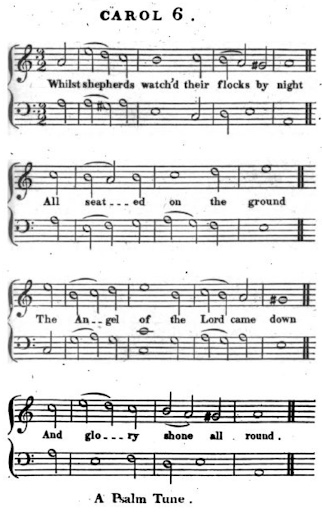
It was not until 1861 in Hymns Ancient and Modern that the text was finally bonded to an old psalm tune from the 16th century called ‘Winchester Old’.8 The tune was repeated in the English Hymnal in 1906 and that is the ‘standard’ tune we sing today. But we still have lovely tunes like ‘Lyngham’, ‘Cranbrook’ and ‘Sweet Chiming Bells’ to fall back on!
Footnotes
1 One minor alteration was from ‘swathing bands’ to ‘swaddling bands (or clothes)’ in verse 4.
2 Tate (1652-1715) was born in Dublin, moved to London in 1676 and became Poet Laureate for William III in 1692.
3 Tate worked with fellow Irishman Nicholas Brady to produce a New Version of the Psalms of David in 1696 and the ‘While Shepherds’ text was added in to a Supplement of that work in 1700.
4 The Church of England was in disarray after the disruptions of the Civil War, when the Puritans banned bishops and the use of the Book of Common Prayer. There was a re-set under Charles II, but further tensions arose at the accession of the catholic James II in 1685, followed by the invitation to the Protestant William III in 1688. Church services became sober, pious affairs and the singing of psalms was the only participation by the congregation. The eucharist was rarely consecrated and there were no hymns. ‘While Shepherds’ was the only seasonal song approved.
5 Visit https://www.villagecarols.org.uk/ for carols from Sheffield (and elsewhere); also https://wgma.org.uk/ for the West Gallery Music Association, which focuses on church music from the 18th and early 19th centuries.
6 In their book Hark the glad sound of Cornish Carols (Francis Boutle, 2017) Hilary Coleman and Sally Burley gathered 34 variant tunes for While Shepherds Watched in Cornwall: personal communication 9 Sept 2026.
7 A nationwide selection of many modern performances of ‘While Shepherd’ tunes is at the Mainly Norfolk website: https://mainlynorfolk.info/watersons/songs/whileshepherdswatchedtheirflocks.html
8 ‘Winchester Old’ was first printed in Thomas Este’s Whole Booke of Psalmes in 1592. It was an arrangement of a previous melody by the musician Christopher Tye.