God Rest Ye Merry Gentlemen


God rest you merry gentlemen: Roud 394: NOBC 151: No ink will here be wasted on the modern debate over the punctuation in the title (where to place the comma), as none of the early versions of the carol had any punctuation marks at all! This carol is all about the Shepherds and their part in the Nativity scene. It is not traditionally sung in churches, perhaps because merry gentlemen would not be thought welcome. Dickens, of course, chose this carol to highlight the meanness of Ebenezer Scrooge, who rejected the little caroler at his door and thereby his own chances of comfort and joy.1
The earliest text we have for the carol is dated c1654 and is part of a compilation of ‘recusant’ (i.e. catholic) poems, hymns and carols, hand-written during the time of Oliver Cromwell’s Puritan Commonwealth. The manuscript is held at the Bodleian Library in Oxford2 and has eight stanzas as opposed to the ‘standard’ seven stanzas as published by Sandys in 1833 and then confirmed with only minor changes in Bramley & Stainer in 1867.3 The missing stanza ran:
With sudden joy and gladnesse
These sheepheards harts were fild (hearts ...filled) To see the babe of Israell
before his mother milde
therefore with mirth and cheerefullnesse
rejoyce each mothers childe
At this tidings of comfort and joye.
This stanza was present (with minor changes) in a broadside dated c1700 in the Roxburghe collection,4 as well as in the ‘Beauties of the Magazines’ anthology of 1775.5 It is there in broadsides by printers J&C Evans of Long-Lane, London (1822-1828) and Croshaw in York6, but was omitted from other early 19th century broadsides and may not have been widely sung for a time. Husk reinstated the stanza in his 1866 book, but Bramley and Stainer omitted it again in 1867 and their version (in its many editions) was the dominant reference.7
The only other point of interest textually is that in the 1654 manuscript the chorus is four lines long, first and last lines are ‘…tidings of comfort and joy’ but sandwiched in between are the last two lines of the previous verse. So, each chorus was different. Whether because of ease of singing or memorising, the chorus was reduced to the thrice repeated phrases in Bramley & Stainer, which we sing today:
O tidings of comfort and joy, comfort and joy
O tidings of comfort and joy.
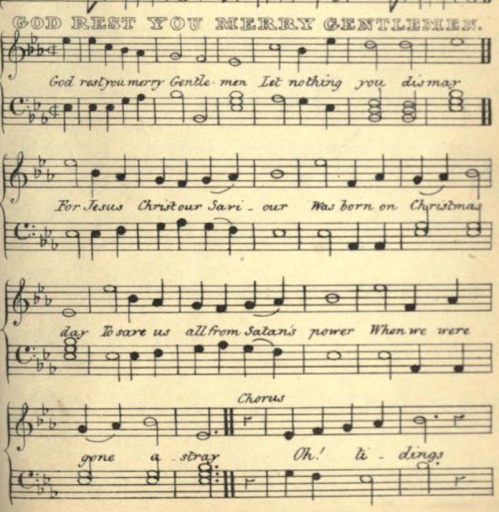
As for the tunes for the carol, there are two basic tunes – the first to be published (probably not the oldest) is the Cornish tune, as presented by William Sandys in 1833: it is in the major key of E flat, starting high and running right down to the root note with subsequent jumpy intervals that may have troubled the average singer.
The second (and now ‘usual’) tune is called the ‘London’ tune. Samuel Wesley (1766-1837), grandson of Charles Wesley, published a pretty Rondo for harpsichord using this tune in about 18108 and in 1820 William Hone wrote a parody song, setting the tune in a G minor key (Aeolian mode: flattened 3rd, 6th and 7th notes).9 When Edward Rimbault laid out the tune in his book A Little Book of Christmas Carols in 1846, he set it in E minor, describing it as an ‘Ancient version, as sung in the streets of London’.10 John Stainer completed the process in 1867 with the fresh harmony arrangement that we sing today – still in E minor (Aeolian mode) – plus the repetitious chorus:
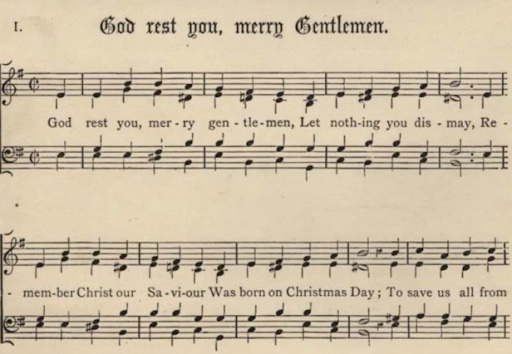
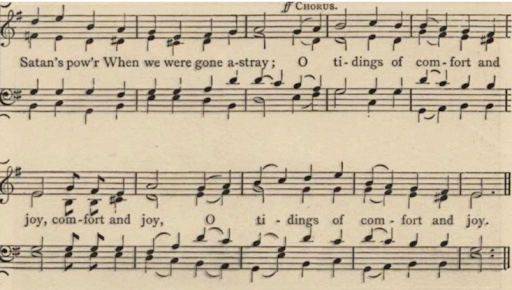
This carol seems to have retained its popularity due to this strong minor tune, which has similar phrases to (and may in truth derive from) a country dance tune Chestnut or Dove’s Vagary in John Playford’s The Dancing Master book of 1651. It’s intriguing to wonder if that was indeed the tune sung by the writer of the original compilation of verse in 1654!11
The final comment on this carol is that it was obviously popular with carolsingers visiting houses (so-called ‘luck-visits’), as in the case of Mr Scrooge. Carolers could improvise a final verse, as they said goodbye and went on to the next house. This was noted by Cecil Sharp when he interviewed Mr Henry Rapsey at Bridgwater in Somerset in 1906. Mr Rapsey had sung Come all you worthy gentlemen as a boy in the streets of the town, ending with:
God bless the ruler of this house and long in may he reign
Many happy Christmases may he live to see again etc…12
It is no surprise either that when Peter, Paul and Mary recorded another ‘luck-visit’ song A’Soalin’ in 1963, they borrowed the ‘God rest you’ final verse ‘Now to the Lord sing praises etc’.13
Footnotes
1 Dickens, Charles, A Christmas Carol (London, Chapman & Hall, 1843) p16.
2 ‘A Collection of recusant verse’, compiled 1651-7: Bodleian Library, MS.Eng.poet.b.5 page 57 (words only, no tune). The catholic community that secretly sponsored this compilation was at Wootton Wawen, nr Stratford-upon-Avon. For an analysis of the context, see Cedric C. Brown of the University of Reading in The Yearbook of English Studies vol33 2003 pp290-315. https://www.jstor.org/stable/3509032?seq=1 Brown does not discuss the carol per se but suggests (p311) that the first line reads: ‘Sit you merry Gentlemen, let nothing etc’, but the writing is scarcely legible.
3 Sandys, William, Christmas Carols Ancient and Modern (London, Beckley 1833, p102); Bramley & Stainer Christmas Carols New and Old (London: Novello, pp2,3).
4 ‘Four Carols for Christmas Holidays’: Roxburghe 3.452 at the British Library - image also at the English Broadside Ballad Archive website at the University of California (Santa Barbara), ref EBBA 31130.
5 The Beauties of the Magazines was printed in 2 volumes in Altenburg, Germany.
6 Croshaw’s broadside is held at the Bodleian Library Douce adds.137 p50. Croshaw was printing at 36 Pavement, York between 1814 and 1850 (approx.).
7 Versions sung today have reduced the number of stanzas to 5 (or even less): e.g. David Willcocks arrangement in Carols for Choirs I in 1961 had 5.
8 Samuel Wesley’s tune is viewable at https://www.notamos.co.uk/detail.php?scoreid=147366
9 Hone’s tune is viewable at https://commons.wikimedia.org/wiki/File:A_Political_Christmas_Carol_(Hone).png
.png)
10 Rimbault’s London tune is viewable at: the IMSLP.org website (Petrucci Music Library).
11 Sharp reset Playford’s tune in his Country Dance Tunes Set 4 book (London, Novello 1911), viewable at IMSLP.org.
12 Rapsey’s text (CJS2/9/818) is clearly a variant of the God rest carol, but his tune is in the D major key and is reproduced in Sharp’s English Folk-Carols book (London, Novello, 1911 p26). It is also in the New Oxford Book no.152.
13 Peter, Paul & Mary A’Soalin’ from Moving album 1963. For separate soul cake custom at Hallowe’en: Hutton pp375ff.