Wassails


Wassails (various): Roud 209, NOBC 155-159:
Introduction
It may seem strange that wassails are included in our study of folk-carols, because they are all purely secular songs with no mentions of the Nativity in their lyrics at all. But, from the 17th century poet Robert Herrick onwards to the Victorian collectors, wassail songs were always called ‘carols’ and their association with the Christmas period is ongoing and indissoluble. There are 5 wassail songs in the New Oxford Book of Carols (as indicated above) and these are treated below after a brief description of the overall 'wassail' custom:
There are two types of wassail events that support or require songs – the House-visiting wassails (door-to-door soliciting of food, drink or gifts) and the Apple wassails (visiting orchards to encourage a new crop). The common theme to all wassail songs is that wassailers are wishing good luck to the householder or farmer alike in the year ahead. In the process they hope some of the good luck rubs off on them too!
Origins of the 'Wassail'
In early medieval times, the word ‘Wassail’ (Old English ‘waes-hael’:1 ‘be you healthy’) began as a simple greeting and was then used as a toast made at a feast,2 but it was later applied to the spicey drink, its bowl and the community event itself. The epic poem Beowulf 3 mentioned wassails and Geoffrey of Monmouth in his History of the Kings of Britain (1136 AD) invented the encounter of King Vortigern (the British king who seized power after the Romans departed in 410AD) with Rowena, a Saxon princess, over a wassail bowl.4 The cleric Wace in his chronicle Roman de Rou alleged that the English soldiers caroused in a wassail all night before the Battle of Hastings.5
In his Chronica Majora work written between 1240 and 1259, Matthew Paris, a Benedictine monk at St Albans, recorded a wassail bowl in which cakes and fine white bread were communally dipped.6 Made usually of wood,7 pewter or silver, the wassail bowl would be decorated with evergreens and ribbons. Hutton records that ‘by the end of the fourteenth century, great families preserved wassail cups of considerable value.’8 King Henry VII treated the wassail bowl with great ceremony at court during Twelfth Night revels.9 A receptacle in rural areas, on the other hand, might be a modest milking-pail, as in John Bale’s play Kynge Johan (King John) of c.1530:
Wassayle, wassayle out of the mylke payle…
Wassayle, wassayle that never will fayle.10
Women wassailers
At some point the wassail bowl or cup left the feasting hall, so to speak, and was carried round the streets. Londoner Henry Machyn, writing in his diary in 1555, records that at a Twelfth Eve party a group of twelve maidens came in singing with their ‘wessels’. They received food and drink for their efforts and (presumably) went on their way.11 This may be the first record of house-to-house ‘luck-visits’. John Taylor, a Thames waterman, writing in 1631, also describes how ‘a company of maids’ entered a rural household where he was a guest ‘with wassell, wassell, jolly wassell: I tasted of their cakes, and supp’d of their bole (bowl)’.12
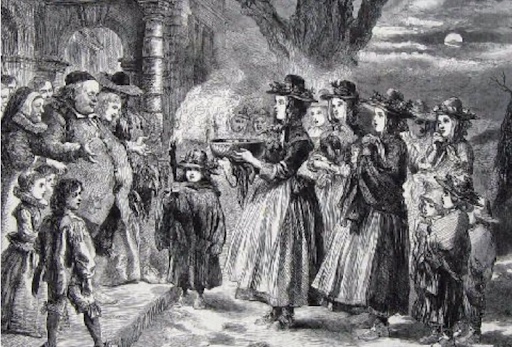
In return the women received ‘white-loafe and cheese, mince pies and other meat’. Hutton suggests that such hospitality towards neighbours and visitors (especially if they were poor) increased during the early 17th century and that payments to ‘wassailers’ featured in gentry household accounts throughout the late Stuart and Hanoverian ages.13 Hutton prefers to bundle these house visits under the heading of ‘Rites of Hospitality’. It must be remembered that, for waged workers especially, the absence of work for twelve days over Christmas was an anxious time and there are records of wassailers going out on various days of the Christmas period seeking sustenance and support from the gentry. The poem A Christmas Carroll by George Wither14 in 1622 has the following lines:
Good farmers in the country nurse
The poor, that else were undone.(v7)
The wenches with their wassell bowls
About the streets are singing.(v10)
Over time, men and children also became involved in visiting wassails, but this varied around the country. Female wassail-bearers continued to be prominent in Warwickshire, Staffordshire and Nottinghamshire into the 18th century and the song that was widely sung in that region was: The Jolly Wassell-Bowl (12 verses):
v1. A jolly wassel-bowl,
A wassel of good ale,
Well fare the butler’s soul,
That setteth this to sale;
Our jolly wassel.v2. Good dame, here at your door
Our wassel we begin,
We are all maidens poor
We pray now let us in,
With our wassel.
We find that printer John Rann published this song in 1819 in Dudley to be sung to the tune of ‘Gallants, come away’. Joseph Ritson had already noted the lyrics in 1790 (Ancient Songs pp304-306), which John Brand reproduced in his 1813 book Observations on Popular Antiquities (pp4-5); and finally William Sandys printed the same words in his Christmas Carols, Ancient and Modern book in 1833 (pp4-5). The 'Jolly Wassel-Bowl' song was inescapable and yet we don’t sing it at all today!
Over time too, carrying a wassail bowl over long distances proved impractical and that element of the custom fell away in some places. Indeed, wassailers were sometimes so bold as to call up the butler of the house to fill and supply ‘a bowl of the best’ for them (either a separate bowl or to top up their own15). If the wassailers did not have a bowl, the wassail song gained in importance as an entertainment offer to the householder, bolstering the convivial performance of the wassailers and defusing any suggestion that they were simply begging. In parts of Yorkshire the bowl was replaced by a small ‘wessel box or cup’ containing dolls representing Jesus and Mary.16 The perambulating bowl seems to have lingered longest in the west country, viz. the last lines of the Gloucestershire Wassail song are: ‘With my wassailing bowl I drink to thee’.
Apple Wassails
Before examining ‘house’ wassail songs in more detail, let us first tackle the Apple Wassail tradition. There are many wassail revivals all around the country today and it is impossible to try to acknowledge all locations and events (sorry!).
Origins
Hutton suggests that the earliest record of an orchard wassail is at Fordwich17 in Kent in 1585. The poet Robert Herrick, who spent 30 years as vicar at Dean Prior18 in the heart of cider country in South Devon, wrote in his Hesperides book (1648):
Wassaile the trees, that they may beare
You many a plum, and many a Peare;
For more or lesse fruits they will bring,
As you doe give them Wassailing.
It seems that trees other than the apple could be wassailed (!), but the antiquary John Aubrey was doubtless referring to cider apples when he wrote (c.1686) that in Somerset on ‘Twelfe-eve…they goe with their Wassel-bowle into the orchard and go about the trees to blesse them,19 and putt a piece of Tost upon the Rootes’.20 The toast (soaked in cider) has been explained away by folklorists and commentators as a propitiatory offering (to whom?) to awaken the trees in mid-winter and ensure a good new crop, while the banging of pots and firing of shotguns is to drive away evil spirits.21 The wassailers themselves could never explain their actions when asked, but insisted that they must perform them, otherwise bad luck would ensue. It must be said that the presence of alcohol-laden toast is a throwback to the original medieval wassail tradition – a subconscious offering of good luck and good health to a tree rather than a person. Just a suggestion.
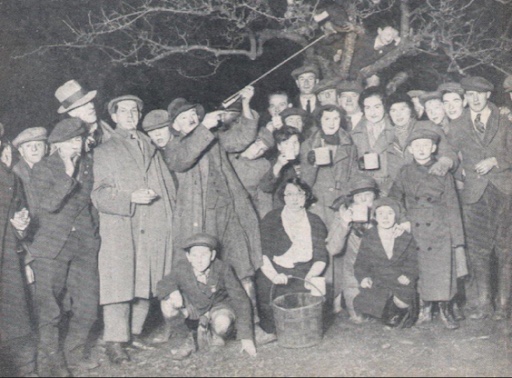
As to the appropriate song to sing at the event, a certain form of words is usually chanted to the trees along these lines (from Devon dated 1791):
Here’s to thee, old apple tree,
Whence thou mayst bud
And whence thou mayst blow!
And whence thou mayst bear apples enow! (enough)
Hats full! Caps full!
Bushel – bushel – sacks full,
And my pockets full too! Huzza!22
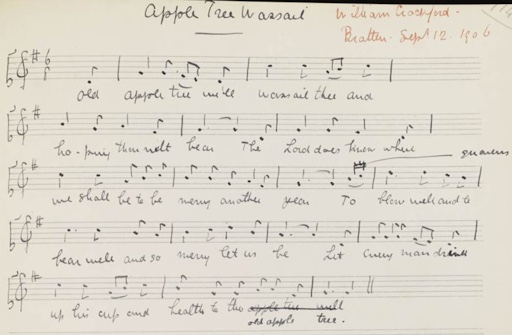
As for a tune to accompany the chant, one that is used at many wassail revivals is that collected by Cecil Sharp from shepherd William Crockford at Bratton, just outside Minehead in 1906; he published it in Folk Songs from Somerset series5 (London: Simpkin, Schott) in 1909.23 Crockford’s tune is a variant (in the major key) of Miller of the Dee, an 18th century tune – this tune is often used in revivals today across the country:
Sharp collected 27 variants of wassail tunes in total (17 in Somerset) - nearly all were house wassails. But charmingly he did report on a ‘Bee worsle’ (wassail) that he was sent in 1903 by a Miss M.E. Durham,24 who had collected it c1890 from Duncton, near Petworth in West Sussex ‘from a man who had worsled every Christmas since I was a boy, barring the year I broke my leg’. She got the words but not the tune unfortunately. What a lovely idea to worsle the bees that do so much to pollinate the apples! According to Miss Durham, the men danced round the apple trees and then the beehives, chanting:
Bees, bees of Paradise,
Do the work of Jesus Christ,
Do the work that no man can…
House-visiting Wassails
Let us now examine house-visiting wassails in more detail, using the New Oxford Book of Carols as a guide:
The Gloucestershire Wassail (NOBC 155), whose first lines are:
Wassail, wassail, all over the town,
Our toast it is white and our ale it is brown
Our bowl it is made of the white maple tree
With the wassailing bowl we’ll drink to thee!
This carol was also in good circulation. John Brand got its words in the 1790s from fellow antiquarian Samuel Lysons, who noted them from wassailers somewhere south of Gloucester.25 Brand’s Observations book in 1813 showed six verses but sadly, no tune. Then in 1866 William Husk printed a tune in his Songs of the Nativity book (p199) – it was in 4/4 time (SATB) and had the same six verses as Brand. The wassailers wish good luck to the farmer and to his horses Dobbin and Smiler and to his cow Fillpail. Better tunes were then discovered, first by Cecil Sharp from agricultural labourer William Bayliss at Buckland, near Broadway in April 1909 – this was a jollier tune in 3/4 time with a repeating last line chorus. He published it in his English Folk Carols book in 1911. Sharp combined the six verses Bayliss gave him with another three verses he already had from another labourer Isaac Bennett at Little Sodbury.26 Another good tune, also in 3/4 time, was found by Vaughan Williams in 1909 from an unknown singer at the Swan Inn at Pembridge, near Leominster in Herefordshire.27 This shows either that a good tune travels far or that the unknown singer had to leave Gloucestershire to find work. There are similarities in the two tunes and when Vaughan Williams published his version in Five English Folk Songs (arranged for SATB) in 1913, he settled for six verses but, like Sharp, he borrowed the final verse from Mr Bennett! It has become the ‘standard’ version of the carol we sing today.
The Gower Wassail, South Wales (NOBC 156) was first recorded by Phil Tanner on a 78rpm record in 1936 in London. Tanner (1862-1950) was known as ‘The Gower Nightingale’ and his wassail was published by A.L.(Bert) Lloyd in his 1967 book Folk Song in England. There were maritime trade and migration links between Somerset and the Gower, and it has been suggested that Tanner’s wassail song may have been influenced by these links.
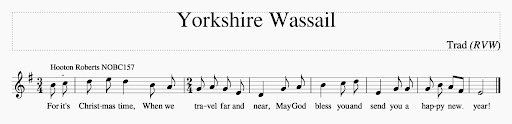
The Yorkshire Wassail Song ‘We’ve been a while a-wandering amongst the leaves so green’ (NOBC 157) was collected by Vaughan Williams from (unknown) singers in the village of Hooton Roberts, near Rotherham. There are no field notes for this collecting (therefore no date), but Vaughan Williams published the song (with six verses) in his Eight Traditional English Carols book in 1919. He there confessed that he borrowed some verses from the ‘Here we come a-wassailing’ carol (see below), of which it may indeed be a close relative. The verse is a variant of the usual ‘God rest ye merry gentlemen’ tune in Eminor, but the tune in the refrain ‘For it’s Christmas time, etc’ bears no relation to the ‘tidings of comfort and joy’ melody and is clearly new (as below):
As a footnote, Vaughan Williams often holidayed at Hooton Roberts to stay with his friend Nicholas Gatty, with whom he had trained at the Royal College of Music. Gatty’s father Reginald28 was the rector at Hooton Roberts (since 1888) and knew the wassail tradition there. Reginald died in 1914, which suggests the carol collecting probably preceded that date.
The Drayton Wassail (NOBC 158) was collected by Cecil Sharp on 22 August 1903 – it was the second song he ever collected (after the ‘Seeds of Love’ that same day). Drayton is just 3 miles from Hambridge in South Somerset. It was not the wassail time of year, but he got the song from the vicar’s daughter Mary Quick, as the wassailers always began their perambulations at the vicarage.29 Sharp returned on 5 January 1909 specifically to watch the wassail performers ‘live’.30 He published the song in Folk Songs from Somerset series5 later that year. The song text is similar to the Gloucestershire Wassail, commencing ‘Wassail, O wassail, all over the town, The cup it is white and the ale it is brown etc’, but there is a jolly refrain in the Drayton version: ‘For it’s your wassail, and it’s our wassail etc’. Clearly the ‘folk process’ of amending texts/tunes was in full swing in this part of Somerset, for Sharp collected three other wassail variants from local folk singers.31 The Drayton tune is in the Mixolydian mode (flattened 7th note) – Sharp called it a beautiful tune and the whole ceremony he thought ‘wonderfully effective…such a pretty and social custom’. It is a living tradition today.
Here we come a-wassailing (among the leaves so green) is another Yorkshire carol (NOBC 159), which still appears in some carol sheets today, but it is perhaps not lustily sung, as there are at least three competing tunes that cause confusion. One tune appeared late (in 1913) in The English Carol Book, co-edited by Martin Shaw, who promoted it because his father had sung it to him when he was a child:
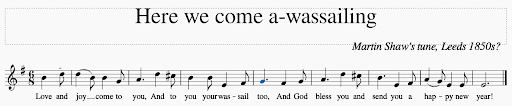
Underneath Shaw noted:
‘The above beautiful traditional tune was sung in the streets of Leeds in the ‘fifties of last century (i.e. the 1850s)…It is, of course, much older than that. I have never seen it in print. The Rev. J.T.Horton, a Bradford parson, tells me that the tune is still well known and often sung by Christmas waits in the West Riding’.32
This tune was selected for the first Oxford Book of Carols (1928) and was repeated (as Tune I) in the New Oxford Book of Carols in 1996. The verses are a variant of the (usual) God rest ye merry gentlemen tune in E minor in 6/8 time but then there is a new refrain and melody in the Dorian mode (sharpened 6th note C). The tune is not easy to sing (despite Shaw’s admiration) and what the layman actually prefers to sing is the tune in E major.
The second tune for this carol had earlier been provided by Bramley and Stainer in 1871 in their influential book Christmas Carols Old and New.33 The ‘God rest ye’ melody for the verses was not used by Stainer and the refrain was switched to 4/4 time with a repeated last line – easier and more memorable (as below). It’s what we sing today.

A third competing tune was that provided by Lucy Broadwood and John Fuller-Maitland in their book English County Songs (1893 pp14,15). This carol is actually titled ‘The Wassail Bough’ and was sent (words and music) to Miss Lucy Broadwood by Herbert Morris Bower (‘HM Bower Esq’). He was born and bred in Ripon, was its JP and Mayor; he was also an eminent scholar of folklore.34 He knew the wassail song at Galphay village, four miles west of Ripon, but also somehow had details from Anston village, near Sheffield, 70 miles away – perhaps through the Folklore Society, of which he was a member. In her notes Broadwood explained that ‘the children carry green boughs and wave them over their heads, asking for a New Year’s gift’. This at last explains the reference in the song to ‘among the leaves of green’.35 The 'Anston tune' has similarities but also differences with the other Yorkshire tunes – it has an extended chorus beginning ‘Our jolly wassail, our jolly wassail’ before the ‘Love and joy’ element. One can imagine the children enjoying the dramatic potential in the tune's pausing at that point.
Ruairidh Greig, in his investigations into house visiting customs in South Yorkshire in 1973, reported that ‘very few wassailing visits appear to have taken place since 1945…one factor mentioned, responsible for the decline…was parental fear for the safety of young girls making such visits after dark’. He did, however, tape-record 7 versions of the ‘Here we come a-wassailing song’ across the region (all slightly different).36 In summary, all the Yorkshire wassails discussed above are clearly the result of ‘folk’ treatment but are of relatively modern creation. Their texts (up to 8 verses) are consistent, however, and refer back to William Husk’s Songs of the Nativity (1866 p152).
Cornwall is not yet represented in our brief survey of wassail songs and there are two that are worth investigating:
The Grampound wassail
Grampound is a village 8 miles east of Truro and c.1890 Baring-Gould, the Devon collector, was sent details of the wassail custom there by John Barrett, an accountant on the Tregothnan estate. The tune was sent by Franklin J Mountford (Mus.Bac, L.R.A.M and A.R.C.M)37, the organist at St John’s Truro, so we can be sure of its merits. Mountford (1863-1927) arrived in Truro from Birmingham in the late 1880s and taught there for twenty years. He caught the tune from Michael Nancarow, a woolcomber, who was born in Grampound in 1817 and learned the wassail as a young man from older men.38 Michael moved to Truro in 1844 but never forgot the wassail custom, saying ‘the singers carry a bowl into which all liquor given is poured, and when they leave the house, they usually carry some away in case they should meet anyone on their way to the next house’. Here is the very jolly refrain:39
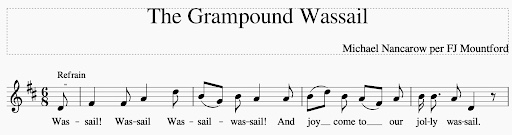
Cecil Sharp collected a (different) Grampound tune from a Mr Browne in 1913 but it is in 3/4 time and rather dull in comparison.40 Baring Gould never published this wassail with its thirteen verses41 and there is currently no living tradition of wassailing in the village. Michael Nancarow died in 1896.
The Jacobstow wassail
Jacobstow (no ‘e’) is a small village, 8 miles south of Bude in Cornwall. It is not to be confused with Jacobstowe (with an ‘e’), which is 5 miles north of Okehampton in Devon. The Jacobstow wassail was sent to Baring-Gould by Mrs Charlotte Batchelor, daughter of Sir William Trelawny and wife of Rev Frederick Batchelor, who was rector of Jacobstow from 1865 until his death in 1897. The couple obviously knew all about the wassail. It’s a quirky song, the lyrics involving a Robin Redbreast, whose function is to provide multiple rhymes to help the song along. Mrs Batchelor could not supply the tune, but luckily the words were well matched to a tune that had been sent in independently by Arthur Lewis Matta (erroneously cited as G.Lewis Maitland in some quarters). Arthur L. Matta was born in 1865 in Mevagissey in Cornwall, the son of an agricultural labourer and left Cornwall at age 13 to become a certificated teacher in Sussex.42 He sent 3 song fragments to Baring-Gould including a wassail ‘as sung in Cornwall in 1877’. Matta wrote that ‘these trifles have been carried in my mind 20 years or more’. At last, his tune found a home! The song has been covered by the Watersons and by Jim Causely.
There is other wassail material in Cornwall, which you can view at cornishnationalmusicarchive.co.uk/content/cornish-wassails/
Footnotes
1 Derived from Old Norse ‘ves-heill’; we still use phrases like ‘hale and hearty’ or ‘hail fellow, well met’.
2 Offering the communal cup, one says ‘waes-hael’ and the recipient replies ‘Drinc-hael’: (I) drink (to) your health.
3 The poem Beowulf was perhaps composed in the 8th century (date disputed). Sole manuscript is in British Library.
4 There is no actual evidence that Rowena ever existed. Vortigern is supposed to have invited the Angles, Saxons and Jutes to come to Britain around 449 AD to help defend against the Picts and Scots.
5 Wace’s book was commissioned by Henry II in 1160AD. He wrote it over many years, living at Caen in Normandy. His comments about the English soldiers are unproven. Translation by Pickering (London 1837 p155) at Internet Archive.
6 Paris, Chronica Majora vol3. To counteract acidity in old wine, toast might be added to the wassail brew - the last recipient of the cup would enjoy the alcohol-laden bread as a reward. Hence our ‘toasting’ someone’s health today.
7 The wood might be from the white maple tree or else brown from walnut or yew or a hard wood like lignum vitae.
8 Hutton, Ronald, The Stations of the Sun (OUP 1996), p13.
9 Henry VII Household Ordinances 31 Dec 1494, Bodleian Library, MS.Rawl.B.47.
10 John Bale (1495-1563) was a pioneer of the historical drama. Shakespeare followed Bale in referencing wassails – Hamlet Act 1 Scene 4; Macbeth Act 1 Scene 7.
11 The Diary of Henry Machyn, ed. J.Nichols (Camden Society, 1848, Internet Archive) p99, as cited by Hutton p13.
12 Taylor, John The Complaint of Christmas p23, Internet Archive. Taylor was complaining against the Puritan dislike of Christmas.
13 Hutton p22
14 George Wither (1588-1667) was initially a moderate in religious views but became increasingly Puritan in outlook, serving as a major in the Parliamentary army in the Civil War.
15 See The Grampound Wassail entry for description of their management of a wassail bowl!
16 Wessel cups, Hutton p64; also Simpson, Jacqueline and Roud, Steve (A Dictionary of Folklore OUP; 2000, pp507-509). The customary wassail song would be sung by the women and children, who received money upon revealing the dolls. The practice took place usually on Christmas Eve. See later discussion of Here we come a-wassailing.
17 Hutton p46. Fordwich is 3 miles NE of Canterbury.
18 Dean Prior is 8 miles W of Totnes with a 14th century church. Herrick went there in 1630 but, as a Royalist, he was ousted from his living in 1647, returning in 1662 until his death in 1674. He wrote extensively on rural customs. His collection of poems Hesperides is viewable online at Internet Archive: edited by LC Martin (OUP 1965, p264)
19 This idea of blessing the orchards is why Hutton classified the Apple Wassail as a Rite of Purification (chapter 5)
20 Aubrey’s manuscript (British Museum, Lansdowne MSS.231) is a compilation of random notes (1686-87), entitled Remaines of Gentilisme and Judaisme (edited by James Britten for the Folk-lore Society, 1881, p40, Internet Archive)
21 Loud noises in the ceremony led to it being dubbed ‘apple-howling’ in some parts of the country: Hutton p47.
22 Apple chant from The Gentleman’s Magazine 1791, reporting from the South Hams in Devon. Hutton p46.
23 Sharp fully discussed both house and apple wassails in this book pp91-96. For William Crockford, see https://cecilsharpspeople.org.uk/william-crockford.html
24 Mary Edith Durham (1864-1944) was a painter, a teacher and an anthropologist. She travelled a great deal and became an expert on the Balkans. She lived in Hampstead where Sharp met her. The ‘Bee Worsle’: CJS2/9/76 at vwml.org. Dorothy Marshall and Clive Carey confirmed the chant in 1911: CC/2/85.
25 Samuel Lysons (1763-1819) was director of the Society of Antiquaries in London 1798-1809. He was born in Rodmarton, 7 miles SW of Cirencester, and always maintained links with Gloucestershire. Husk noted that in 1864 the carol was sung on New Year’s Eve in the village of Over by wassailers from Minsterworth.
26 Sharp met Bennett in April 1907 (CJS2/10/1286) and Bayliss in April 1909 (CJS2/10/2132) at vwml.
27 Vaughan Williams variant is at RVW2/1/162 at vwml.org; Five English Folk Songs was published by Stainer & Bell.
28 Rev. Reginald A. Gatty (1844-1914), educated at Christ’s college, Cambridge, was an archaeological expert in flint artefacts and a local historian. In 1907 he noted the children’s singing of ‘Here we come a-wesseling’ at Wickersley village 4 miles away (Birmingham Ref Lib 661164 11R 20 n/book 3 pp7-8). Perhaps this inspired Vaughan Williams.
29 Rev Henry Quick was vicar of Drayton between 1893 and 1912, so the family knew the wassail tradition well.
30 Sharp had no need to re-take the tune but did note the spoken greeting of the foreman (retained today): CJS1/9/1/1909/1 p7: ‘God bless the master and missus and all the family, wishing you a merry Christmas and a happy* New Year and many of them’. * today ‘bright and prosperous New Year’.
31 Wassails from Alfred Emery (Othery), Emma Overd (Langport) and Harry Richards (Curry Rivel): each distinctive.
32 The English Carol Book (London, Mowbray 1913 p29). Composer Martin Shaw (1875-1958) collaborated with Rev Percy Dearmer in the production of two English Carol Books (1913, 1923) and the first Oxford Book of Carols in 1928.
33 John Stainer fails to reveal the true source of the tune on p184, stating merely ‘Traditional (Yorkshire)’.
34 Bower (1854-1940) was educated at Trinity college, Cambridge and admitted to the Bar in 1883.
35 Only the Yorkshire wassail songs mention ‘green leaves’.
36 Greig, Ruairidh ‘Wassailing in South Yorkshire’ in ejournal Tradition Today issue no.1 April 2011: http://centre-for-english-traditional-heritage.org/TraditionToday1/TT1_Greig.pdf. As well as wassail boughs, children in other parts of South Yorkshire carried a ‘vessel cup’ (or box, containing a doll representing The Virgin Mary) as previously discussed in this section. Also Roud, Steve The English Year (London, Penguin 2006, pp507-509).
37 FJ Mountford’s post and qualifications in advertisement in The West Briton and Cornwall Advertiser 4 Oct 1900.
38 One of the older men to instruct Nancarow was William Griffin, who was born in Grampound in 1785.
39 Nancarow’s tune is at SBG/3/1/743 at vwml.org
40 Sharp’s collected tune is at CJS2/10/2852 dated 13 May 1913.
41 The reference for the Grampound tune is SBG/3/1/743 at vwml. I am grateful to Martin and Shan Graebe for their advice and transcriptions for this song.
42 Matta taught at Wivelsfield, at Petham and at Canterbury.