Virgin Most Pure, A


A Virgin Most Pure (Unspotted): Roud 1378, NOBC 143: Although today this carol is sung more by specialist choirs or folk artists than by congregations or carollers, it was immensely popular in the 19th century and was published in nearly all the carol books of that era. It has a good chorus, which may explain its early popularity, but it has perhaps been overlooked in recent decades.
The earliest version is a song entitled ‘In Bethlehem City’, published in London in 1661 as one of twelve New Carolls for this Merry Time of Christmas.1 It should be remembered that the Puritan ban on Christmas was revoked soon after King Charles II was restored to the throne in May 1660. It was therefore good timing to produce such a book! The carol had 13 x 2-line stanzas with 11 syllables to a line throughout. It began with a two-line burden (refrain):
And therefore be merry, set sorrow aside,
Christ Jesus our Saviour was born at this Tide.
The presence of such an opening burden might suggest a medieval antecedent for the carol, but no manuscript has matching texts.2 The carol basically told the whole Nativity story in one snatch – the journey to Bethlehem to be taxed, no room at the inn, a simple stable and ox-manger, the shepherds and angels, wise Princes and gifts. The tune suggested in the (words only) 1661 book was ‘Why weep ye’, which is now lost and forgotten.
The verses were a lot to remember and, unsurprisingly, subsequent printed versions reduced the text. The ‘Johnson Ballad #1365’ c.1760 (held at the Bodleian) compressed the song into 7 x 4-line stanzas but actually inserted a new first verse, giving us a new title:
‘A virgin most pure, as the Prophets did tell,
Should bring forth a young son, as it befell,
To be our Redeemer from Death, Hell and Sin,
Which by Adam’s transgression we were wraped in.3
A tune had been previously published by William Knapp in his book Anthems for Christmas Day (London: 1743); it was in the key of G in 3/4 time with the first phrase repeated in the second line and a modulating note at the end of the third line4 (‘Death, Hell and Sin, as below). The 2-line refrain was retained.
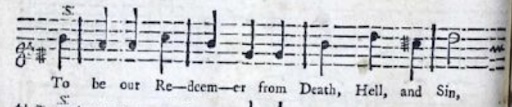
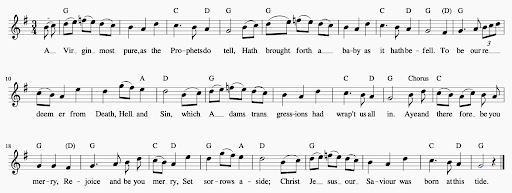
Broadsides kicked the carol on into the 19th century with examples around the country (Bloomer, Watson in Birmingham; Kendrew in York; Armstrong in Liverpool; Wilkins in Derby).5 Then a West Country tune was published by Davies Gilbert in the first (1822) edition of his Some Ancient Christmas Carols book. It’s an attractive tune in the mixolydian mode (flattened 7th note) with seven verses and refrain – this is what Maddy Prior sang6 (as below):
In his 1833 book William Sandys (who was not a musician) published yet another tune, strangely barred in 4/4 time, which Bramley & Stainer switched back into ¾ time in their first book of carols in 1867.
Of course, the folksong collectors were investigating the carol all the while – Lucy Broadwood and John Fuller-Maitland published a version of ‘A Virgin Unspotted’ from Herefordshire in English County Songs (1893, pp78-79); Vaughan Williams got two tunes (also in Herefordshire);7 Frank Kidson noted Mrs Kate Thompson in Knaresborough, Yorkshire and Sharp found six singers, in particular Henry Thomas of Chipping Sodbury in Gloucestershire.8 Subsequently Peter Kennedy recorded a variant by Emily Bishop in Bromsberrow Heath, Gloucestershire in 19529 and Bob & Jackie Patten recorded Charley Williams of Bream, Gloucestershire in 1977.10
In conclusion, we have an old, very resilient and popular carol that is now fading from modern memory. Pity.
Footnotes
1 The only surviving copy is held in the Bodleian Library in Oxford. For notes on all 12 carols: https://www.hymnsandcarolsofchristmas.com/Hymns_and_Carols/Notes_On_Carols/new_carolls_1661.htm
2 A few 15th and 16th century carols in Greene (e.g.11, 15-17) exhort general merriment in their 8-syllable burdens, such as: Make we mery in hall and bowr/This tyme was born owr Savvowr (Greene no. 27 p20: Balliol college, Oxford MS.354)
3 Carol II Three New Christmas Carols. Printed and sold in Aldermary Church Yard, London, 1770, Bodleian Library.
4 The modulating note here is a C♯, the 4th note of the scale, making an ‘A’ chord. This modulation would be retained in subsequent tunes for the carol (but usually at the 6th note), whether by musician (e.g. Stainer) or by folksinger (Henry Thomas, Sharp’s informant). The repetition of the first four bars was maintained by all ‘new versions’.
5 Some broadsides are entitled ‘A Virgin Most Pure’, but others ‘A Virgin Unspotted’ - details of all broadsides are at: https://www.hymnsandcarolsofchristmas.com/Hymns_and_Carols/Notes_On_Carols/in_bethlehem_city__notes.htm
6 Maddy Prior and the Carnival Band on their first album A Tapestry of Carols 1987 (but transposed to key of C).
7 Vaughan Williams from Mr Lewis in 1909 RVW2/1/159 and Mr Dukes in 1912 RVW28/16, both at vwml.
8 Henry Thomas’s version was published in Sharp’s English Folk-Carols book in 1911 pp36-37.
9 Emily Bishop’s version is in Steve Roud and Julia Bishop’s book The New Penguin Book of English Folk Songs p372.
10 Charley Williams’ version is at British Library Sound Archive 1CDR0010869.