Twelve Days of Christmas, The


The Twelve Days of Christmas: Roud 68, NOBC 133: This carol makes no mention at all of the Nativity story and is purely secular in meaning and intent, being tied to Twelfth Night celebrations.1 The text first appeared as a forfeit game in a children’s book called Mirth without Mischief in 1780 in London.2 The original book is worth inspecting, as it has interesting woodcuts as well as another fun game called ‘The Gaping Wide-Mouthed Wadling (sic) Frog’, in which a random object or toy is passed around the circle and each child has to remember a succession of unlikely animals that the object may represent – a frog initially, then numbers of monkeys, puppies etc. Any mistakes require a forfeit to be paid to an appointed ‘treasurer’. At the end of the game (12 rounds), the forfeits are called in and some children have to perform small penalties. The Twelve Days of Christmas was just such a party game. In the carol, a different gift is added each round and all gifts must be remembered exactly.
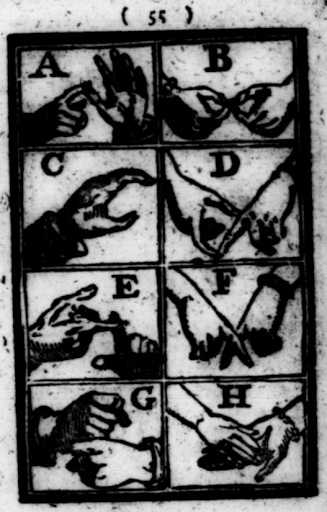
One intriguing extra section in the Mirth book was a very early diagram of the deaf alphabet (as shown below).3 How good to include deaf children in their party games!
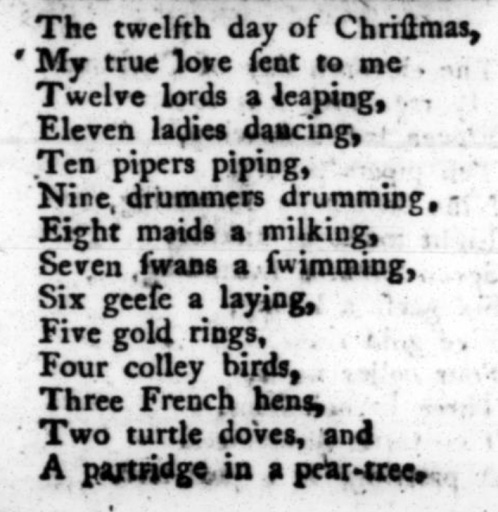
There are no particular surprises in this early text of the carol (above) – none of us remember the exact sequence very well! Note ‘colley’ birds – deriving from ‘coal’ i.e. black birds.
The carol naturally found its way next into Halliwell’s book The Nursery Rhymes of England (obtained principally from oral tradition) in 1842.4 Alice Gomme in her book The Traditional Games of England, Scotland and Ireland (1898) discussed the different ways that children sing and dance this carol around the regions.5
Indeed, children seem to have been the principal means of oral transmission of the carol – there were few broadsides6 and the carol compilers were slow to include it in their books.7 John Collingwood Bruce and John Stokoe published a version from the North East of England in 1882.8
The Edwardian collectors had slim pickings – Sharp was most active, collecting ten versions in Somerset, one each in Cornwall and Herefordshire. He stumbled upon Louie Hooper’s version at his first Christmas party at Hambridge vicarage with Rev Charles Marson in December 1903. She sang of ‘Eleven bulls a-beating; 10 asses racing…’ among other gifts. Sharp published Hooper’s version in Folk Songs from Somerset series 2 (1905) and paired it with a version by a William Brister, who was so drunk on the August day in 1905 that Sharp had to visit him again next morning to catch his songs better, when he was sober.9
So, it seems that this carol was kept alive and enjoyed by children for a couple of centuries, whether at Twelfth Night parties or not. This changed when in 1909 a singer and minor composer named Frederic Austin published what has become the standard tune and most consistent text of the carol.10 It was Austin who introduced the novel pause at ‘Five Gold Rings’. The recent success of the carol on TikTok may now influence the carol going forward.
In conclusion, we must say that this old carol was probably inspired by French carols with a very similar structure – Iona and Peter Opie particularly cite a game/song from Northern France called ‘Les dons de l’an’, which enumerates all the birds and animals that can be deliciously cooked (ducks, rabbits, turkeys, hams) as gifts to your loved one. Very French.11
Footnotes
1 The Canadian hymnologist Hugh McKellar (1932-2012) tried in 1979 to give the Twelve Days of Christmas hidden meanings, suggesting that it was designed to teach the catechism to persecuted catholics from Elizabethan times onwards, but there is no evidence for this claim and it has been quietly debunked. Subsequent article by McKellar in The Hymn vol 45, no.4 (Oct 1994) pp1-6. A real rabbit hole.
2 Mirth without Mischief is viewable online on the Internet Archive platform. The publisher was C.Sheppard and the booklet cost 3d; it went through several editions and was pirated by other publishers. The opening verse of the book reads: Here’s mirth without mischief and fun without fear; Here’s pastime enough for to last the whole year’.
3 The diagram is actually from the 1800 edition of the book, which is the viewable online edition.
4 James Orchard Halliwell (1820-1889) was a Shakespearean scholar and antiquarian. His Nursery Rhyme book was published by Clarendon Press. The fifth edition published by Frederick Warne in 1886 is online (Internet Archive pp184-88).
5 Gomme’s book (London: David Nutt, 1898) is viewable online at Internet Archive. Gomme reprinted the tune from Rimbault’s book on Nursery Rhymes (London: Cramer, 1861). Her discussion is at pp315-321.
6 One notable broadside was by printers Angus of Newcastle at Bodleian Library: Harding B25 (378) date 1774-1825.
7 The first book to feature the carol was Husk’s Songs of the Nativity (1866). Words only pp181-185.
8 Bruce-Stokoe book Northumbrian Minstrelsy (Newcastle-upon-Tyne: The Society of Antiquaries, pp129-131). Viewable online at US Archive.
9 For Hooper & Brister: CJS2/10/49 and CJS2/10/608 at vwml. Also https://cecilsharpspeople.org.uk/
10 Frederic Austin (1872-1952) was a teacher at Liverpool College of Music; he published the carol with Novello.
11 French song: Eds. Iona & Peter Opie, The Oxford Dictionary of Nursery Rhymes (OUP, 1951 pp139-143).