I Saw Three Ships (As I Sat on a Sunny Bank)


I saw three ships (As I sat on a Sunny Bank): Roud 700: NOBC 148: This too is an odd carol in that, in the fifth verse of the ‘standard’ lyric, the three ships carrying Jesus and Mary supposedly sail into landlocked Bethlehem ‘on Christmas day in the morning’.1 The nine verses of the carol, published first by Sandys in 1833 and then replicated by Husk in 1866 and by Bramley and Stainer in 1871, maintain this nautical impossibility.2 Some sort of explanation is required, as there is no Biblical nor Apocryphal story to justify such an imaginary voyage. The general consensus still holds that the carol was inspired by the transfer of the relics (bones) of the Three Kings (Magi) from Milan to Cologne by its Archbishop Rainald in 1164.3
It’s not clear how any ships could be involved in this transfer, as the river Rhine, although it flows through Cologne, flows northward to the North Sea and Milan is not situated on a river or sea coast anyway. Records suggest a land route over the Alps, but this is pedantry applied to a visionary carol. A special shrine was commissioned in 1181 in Cologne to display the sacred relics and the story spread across Europe. The link with the Magi was then lost over time, perhaps with the Protestant distrust of shrines and relics. As passengers on the three ships, the kings were eventually replaced by the Holy Family with Joseph on board too.4
A few broadsides at the start of the 19th century limit the passengers in the three ships to just ‘Joseph and his fair Lady’.5 These early broadsides, all entitled ‘As I sat on a Sunny Bank’, have only four verses and are told from the point of view of the casual observer, who just happens to see the ships and wonders who is on board and where they are going. Homely stuff, ending with the quaint lyric:
(Joseph) O he did whistle and she did sing,
And all the bells on earth did ring
For joy that our Saviour was born
On Christmas day in the morning.
If we want to venture further back in time with this carol, Sandys, Sharp and others were happy to quote from a compilation work by a Scottish musician John Forbes, writing in 1666,6 who printed the music for a long poem that praises aspects of the Trinity and of the Annunciation, but also has the following lines:
There comes a ship far sailing then,
Saint Michael was the stieres-man;
Saint John sate in the horn:
Our lord harped, our lady sang,
And all the bells of heaven they rang,
On Christ’s sonday at morn.
Although there is only ONE ship in this poem, there are similarities of motifs that suggest this may be a precursor of the carol to come. The song clearly bounced around in folk circles as a song for individuals rather than for choral arrangements. It had a simple melody – based on the Nancy Dawson tune from the 18th century.7 The Bramley & Stainer tune from 1871 (below: modern notation) is what we sing today.
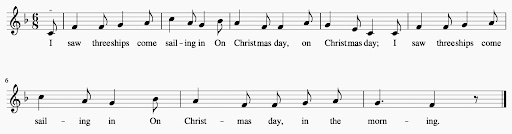

The first date for collection of the carol from an individual singer is 1882 when Cecil Sharp’s sweetheart (and future wife) Constance Birch, aged 20, took it down from a 12-year old boy Charles Poole in her Sunday school at Wootton-under-Edge in Gloucestershire. Constance later sang it to Cecil, who entitled it ‘As I sat on a sunny bank’ (the preferred folk name) and published it in his English Folk-Carols book in 1911 (pp28, 65).8
Lucy Broadwood published a version in her English County Songs book (p111) in 1893 from Hertfordshire. She had received the song as sung by Mrs Clara Wilson, whose husband Cornelius was the gardener at Barnes Lodge, Kings Langley.9
In 1895 Baring Gould published an interesting variant of the carol in A Garland of Country Songs (London, Methuen, p27), which was sent to him by Mr Louis Davis, an artist friend from Pinner in Middlesex, who had noted it from a boatman on the Humber river near Hull. Maybe the boatman’s Yorkshire dialect was too much for Mr Davis, but in verse 3, the ship’s crew say they have got ‘three crawns’ to take to ‘Coln upon Rhine’ and that they were coming from Bethlehem. ‘Crawns’ could be ‘crowns’ or perhaps ‘craniums’ or skull bones. Anyway, it would appear that the ancient relics story was still going the rounds.10
Footnotes
1 Bethlehem is 45 miles from the open sea of the Mediterranean and is 775 metres above sea level with no rivers nearby.
2 Bramley & Stainer made a minor change in v3: ‘Our Saviour Christ and his lady’ to ‘The Virgin Mary and Christ’.
3 The Empress Helena, mother of Constantine the Great, brought the relics to Constantinople in the 4th century, but they were removed to Milan, whence the German Emperor Frederick Barbarossa passed the relics to Rainald.
4 The myth of Joseph coming to Glastonbury arose in the 13th century and may later have exercised influence over the ‘Three ships’ story in popular imagination.
5 In English Folk-Carols Cecil Sharp cites Wadsworth, printer in Birmingham between 1812-17 (from his own collection of broadsides: CJS1/10/2/427). See also Bloomer, Catnach at Bodleian.
6 Forbes Cantus, Songs and Fancies to Three, Four or Five Parts in ‘Aberdene’. The text was reprinted by Joseph Ritson in Scotish Songs (London: Johnson & Egerton, 1794: vol 1, p104), the music was reprinted in Gant p64.
7 The tune appeared in John Gay’s The Beggar’s Opera in 1728, which was revived at Covent Garden in 1759. Nancy Dawson found fame then as the dancer of that hornpipe tune and became a national figure. It is in 6/8 time and is adopted as the tune also for Here we go round the mulberry bush and Here we go gathering nuts in May.
8 Sharp’s entry at vwml is at CJS2/10/2708 where ‘CDS’ stands for ‘Constance Dorothea Sharp’. See Charles Poole at www.cecilsharpspeople.org. Sharp noted 4 other variants eg. Mrs Beechey of Shipston-on-Stour (CJS2/10/2613). For children’s use of the carol, see Opie, Iona and Peter Oxford Dictionary of Nursery Rhymes (OUP, 1951 pp454-5).
9 Clara Wilson (1848-1921): her tune is noted at LEB/2/93 at vwml; Clara is in the 1891 census RG12/1123 p8.
10 Baring Gould’s variant is at SBG/1/3/38 at vwml. Baring Gould himself was sceptical of the authenticity of the Cologne relics, Book of the Rhine (Methuen: 1906, p102). I am grateful to Martin Graebe for his advice with this song.