First Nowell, The


The First Nowell Roud 682, NOBC 137: This carol looks like a folk-carol, sounds like a folk-carol, but its folk credentials and provenance are really quite thin. There seem to be no broadsides1 or cheap printings of it in the 18th and early 19th centuries to build up transmission energy; collectors like Lucy Broadwood, Frank Kidson and Baring-Gould at the end of the 19th century found no ‘wild’ tunes or texts - everybody was singing what the carol books of William Sandys and John Stainer had prescribed. This carol just turned up in Cornwall early in the 19th century, fully formed and ready to go; but even its publication by Davies Gilbert in his 1823 book Some Ancient Christmas Carols is problematic…
Davies Gilbert (1767-1839) was the son of Rev. Edward Giddy,2 curate at the parish church of St Erth village (6 miles S of St Ives in West Cornwall) from 1757 to 1775. When the vicar of St Erth died in that year, Edward Giddy was hoping to take over the parish but he was overlooked and he resigned his curacy, moving to Penzance where son Davies soon began attending the grammar school. However, in 1779 Edward Giddy’s mother-in-law died, leaving Tredrea,3 a 17th century manor farmhouse in St Erth to Edward’s wife Catherine. Edward was installed again at the church there and the family lived at Tredrea for many years. This is important because the young Davies Giddy spent many happy years at this house, was home-educated there and eventually took it over as his married residence when his father died in 1814. Davies remembered the excitement of carol parties there at Christmas time and, approaching his 40th year, he must have decided to rescue and publish the carols he loved from whatever sources he could find.4 Among his papers is a carol book, the so-called ‘Hutchens Ms’ which contains a letter addressed to Davies – it is a reply that he received in June 1816 from John Morgan, the innkeeper of the Star Inn at St Erth:5
‘I have at last procurd (sic) a person to fulfil your request respecting the old Christmas tunes, & as he is a labouring man, perhaps I shall not be able to procure them as soon as I could wish, nevertheless you may rely on my attention to procure them as early as possible… NB I have proposed to have a small book to prick the notes in.’
This tells us two things – that Morgan is prepared to act as mediator6 to locate these old carol tunes and secondly, that he feels he has enough musical competence himself to ‘prick out’ the tunes. In fact, there is a strong similarity between Morgan’s handwriting in this 1816 letter and the handwriting of the subsequent ‘Hutchens’ carol book with its 38 carols and tunes. But the ‘Hutchens’ book is certainly not small and took several years to appear - an expert may have to adjudicate whether the handwriting is identical. The ‘Hutchens book’ is in fluent copperplate style, a fair copy handwritten text with hand-drawn staff notation. All carols are melody line only, no Bass or other parts. There is unfortunately no date visible in the book and some commentators suggest a date as late as 1825. It is an incredible insight into late 18th century carol music and must have required a great deal of time and care. No field notes nor rough copy have survived.
There is an acknowledgment in the opening pages: ‘A Book of Carols collected for Davies Gilbert Esq., MP and FRS by John Hutchens’. But nobody has managed to trace exactly who ‘John Hutchens’ was. There are at least two possible scenarios:
- John Morgan could not fulfil his promise and withdrew altogether. John Hutchens stepped in and just happened to have incredibly similar handwriting to John Morgan; he was musically competent and was the genuine compiler of the book. He may have collected the carols from ‘live’ singers or perhaps he simply copied other documents like musician tune books. Either way, his eventual book was a clean ‘faircopy’ when presented to Gilbert… OR,
- John Morgan did do his job, contacted the ‘labouring man’ who was John Hutchens; whereupon Hutchens sang most or all of the carols,7 but needed the mediating hand of John Morgan to record them. In such a case, Hutchens was perhaps known in the area as a gifted singer/musician – unfortunately, there is no record of any ‘John Hutchens’ in St Erth parish records at all, but there were three ‘John Hutchens’ at St Buryan (13 miles to the south), one of whom was the manager of the new Bible Christian chapel there.8 Non-conformists were known for their singing congregations. Some Anglican churches had West Galleries too, where musicians could lead the congregations in song – the West Gallery in St Buryan church was not removed until 1851.9 It must be said that there were other branches of the Hutchens family in the St Just area and west of Penzance generally, so we may never know the exact identity of Mr John Hutchens.
Davies Gilbert did, however, have other carols material to hand without consideration of the ‘Hutchens book’.10 There is an exercise book, dated ‘Xmas 1817’, in his own handwriting with 12 carols in it, including the First Nowell carol.11 He noted that 8 of these carols ‘used to be sung at Tredrea’ - indeed 6 of those carols form the entire body of the 1822 (first edition) of his carols book. He also noted in this exercise book that the carol entitled ‘Know well, Know well’ was ‘evidently a corruption of Noel’.12 Perhaps for this reason, he did not put it forward for the 1822 book,13 but he did insert it into the 1823 expanded edition (20 carols, 7 tunes). So, there it was - ‘The First Nowell’ for the first time in text but without a tune. It’s not clear why he withheld the tune. Gilbert published nine stanzas of the carol, but we only sing six today.14
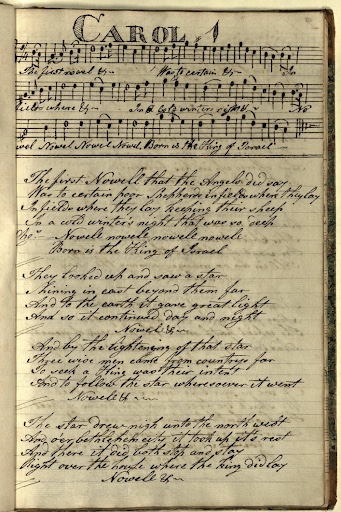
It was William Sandys, fellow antiquarian (also of Cornish descent),15 who published the first tune for ‘The First Nowell’ in his book Christmas Carols, Ancient and Modern, Including the Most Popular in the West of England (London: Beckley, 1833). Sandys (1792-1874) was an enthusiastic amateur musician and antiquary; he was born in London, living and working as a solicitor there all his life. He insisted that his selected carols were ‘still used in the West of England’ (p61), but he never revealed the precise sources of his carols, when or where collected. He may well have had sight of Hutchens’ tune (shown above), changing it from the key of G into the key of D with a 3/8 time. With a little tweaking later by John Stainer in his 1867 book of carols,16 it is recognisably the tune we sing today.
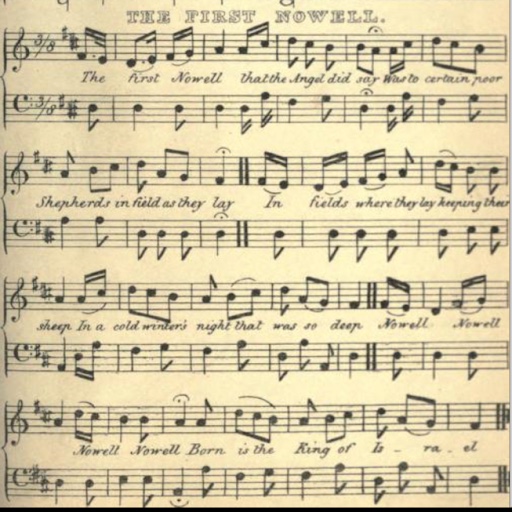
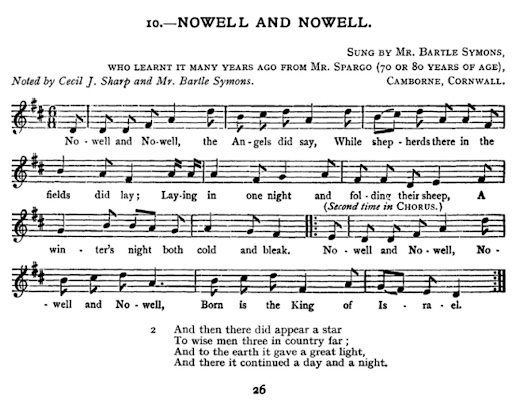
There remains another point of contention about this carol – over its tune. Some musicologists have noted that the Nowell tune hardly uses the root note of D throughout the song and doesn’t settle on D at the end either. They argue that it therefore probably originated as a descant or higher track above a lost or forgotten main melody. We shall never know. Cecil Sharp collected a version with five verses that did begin and end on the root note and published this in the Journal of the Folk Song Society vol 5 (1914, pp26-27).17 It is occasionally sung today but no great claims are made for it (as shown below):
When Ralph Dunstan, the prominent Cornish musician, published The Cornish Song Book (Lyver Canow Kerenewek) in 1929,18 he presented a chorus that went ‘O well, O well, O well, Born is the king of Israel’. So, it seems there was always some fluidity of this text in Cornwall.
In summary, The First Nowell is a uniquely Cornish carol, which dates from at least the 18th century and which was shakily preserved by Gilbert and Sandys. Its echo of the Old French word ‘Noël’ suggests that the carol may have older, late medieval antecedents but perhaps no direct lineage.19 The maritime and cultural links between Cornwall and Brittany may have kept the carol alive in Cornwall over time.
Note 1: on the date of ‘Hutchens book’: Davies Gilbert’s 1823 carol book repeated the 6 carols from the 1822 book but added a further 14 carols, of which 7 appear only in the Hutchens book and not in Gilbert’s other source material.20 We should, therefore, conclude that the ‘Hutchens book’ was in Gilbert’s hands during 1823 in time for publication of his second carol book.
Note 2: on the etymology and use of the word ‘Nowell’: Gilbert knew that ‘Nowell’ was a corruption of ‘Noël’, an Old French word, derived in turn from Latin natalis, meaning ‘birthday’.21 Medieval ‘Noël’ songs in France from the 14th century onwards told the Nativity story to the people, using simple folk tunes and language, so that eventually the word ‘Noël’ became a shout of joy rather like ‘Alleluia’ and might be used in a variety of situations. This is why Gilbert in the Preface of his 1822 book, cited the French writer Gilles Ménage,22 who had stated:
‘Le mot de Nouel étoit autrefois un mot de re-jouissance; on le crioit dans toutes les fêtes et solennités publiques.’
The word ‘Noël’ was formerly a word of rejoicing; one cried it at all celebrations and public feast days.’
Using this original meaning, The First Nowell therefore becomes ‘The first shout of joy the Angels did say was to certain poor shepherds etc’. Makes a lot more sense!
1 There was rumour of an 18th century broadside in Helston, Cornwall but evidence of it is still awaited.
2 Davies Giddy changed his surname to ‘Gilbert’ in 1817, so that he could inherit a legacy left to his wife Mary Anne.
3 Tredrea is a listed building today on the outskirts of the village of St Erth.
4 It would be several years before Gilbert’s book came out (first edition 1822), entitled Some Ancient Christmas Carols with the Tunes to which they were formerly sung in the West of England. Gilbert was an antiquarian and MP as well as ‘chemist, classical scholar, geologist, mechanical engineer, farmer and President of the Royal Society 1827-30’. AC Todd Beyond the Blaze biography of Gilbert (Truro: Bradford Barton, 1967 p.2).
5 Morgan’s letter is loose-leaf, tucked into the book that is commonly referred to as ‘Hutchens MS’, held at Kresen Kernow (formerly the Cornish Records Office) at Redruth ref: DG/92. John Morgan’s dates are 1765-1843.
6 Davies Giddy (as he was at the time) became MP for Helston in 1804 and then MP for Bodmin from 1806 till 1832. He was therefore away in London for parts of the year and turned to John Morgan for assistance.
7 The implication of John Morgan’s letter is that he had to look far and wide for these old carols and that his ‘labouring man’ may not have been in St Erth itself. There are indeed no baptism or burial records for a John Hutchens in St Erth (search Online Parish Clerk, Cornwall). There were, however, many Hutchens families in the Penzance area, southwards to Paul and westwards to St Just and nearby villages. Investigations are ongoing. We may never know who John Hutchens was and what his contributions were, nor whether he came from a non-conformist background or an Anglican background.
8 The 1815 Bible Christian chapel at St Buryan: https://west-penwith.org.uk/wpenchap.htm By 1851 this meeting room had seats for 170 people. I am grateful to Suzanne Tytherall for sending me the 1851 religious census extract for St Buryan, showing John Hutchens as manager at the Bible Christian chapel.
9 West Gallery removal: https://www.stburyanchurch.org.uk/historical-church/the-church-building/. There is evidence of 168 bands in churches and chapels across Cornwall in the 19th century. St Buryan church paid for a clarinet in 1817, a violin in 1826 and a bass viol in 1827. The harmonium did not arrive until 1880. Harry
Woodhouse Face the Music, Church and Chapel Bands in Cornwall (Cornish Hillside Publications, 1997). Visit https://www.penwithlocalhistorygroup.co.uk/the-penwith-papers/?id=70 See ‘Major Influences’ in this website.
10 The ‘Hutchens book’ was used by the English composer Inglis Gundry in his book Now Carol we (OUP: 1966), with sub-title ‘Twelve carols from an old Cornish manuscript edited and arranged for unaccompanied mixed voices’. Gundry had borrowed the ‘Hutchens book’ from a descendant of Davies Gilbert, Minnie Gilbert, but perhaps did not see or else ignored John Morgan’s letter, which Gilbert thought important enough to preserve among his estate papers. It was Gundry who proposed a date of 1825 for the book (Last Boy of the Family, Thames Publishing, 1998).
For Gundry’s use of ‘Hutchens’, see https://www.cornishtrad.com/tunes/origins-of-karol-korev/
11 The exercise book is ref DG/133 at Kresen Kernow.
12 Gilbert’s comments on ‘Know well’ are in a footnote on the Contents page at the front of the exercise book.
13 Gilbert’s reluctance to use the corrupted ‘Know well’ carol in 1822 is confirmed by his Preface in that first book: ‘The French noel …appears corrupted into “Now Well” when it forms a part of the Chorus in the fourth carol; and perhaps indicates the whole to be a translation’. The ‘fourth carol’ he refers to was When Righteous Joseph wedded was, whose chorus reads: ‘Then sing you all, both great and small, now well, now well, now well’. This chorus has endured all the way through to The New Oxford Book of Carols carol (129).
14The missing verses begin: v5. Then did they know assuredly within that house the King did lie…; v7. Between an ox stall and an ass, this Child truly there born he was…; v9. If we in our time shall do well, we shall be free from death and Hell… None of these verses trip off the tongue and were understandably dropped.
15Sandys and Gilbert were in fact distantly related. They both lived in London and it’s possible that they shared information on carols. Sandys was a member of the Percy Society and a fellow of the Society of Antiquaries. He studied the violincello.
16Neither Gilbert nor Sandys were highly trained musicians. John Stainer tidied the tune and added harmonies for The First Nowell, which is carol 6 (p12) in Bramley and Stainer’s Christmas Carols, New and Old (London: Novello 1867).
17Bartle Symons (b1874) lived in Camborne where Sharp visited him in May 1913 (CJS2/10/2846 at vwml); Thomas Spargo (b1811) lived near him and gave him the song. Spargo’s tune is therefore early 19th century in origin. Spargo was stepfather to Bartle’s grandmother. See www.cecilsharpspeople.org.uk
18The Cornish Song Book (Lyver Canow Kerenewek) was published by Reid Bros Ltd in London. https://cornish-language.org/product/lyver-canow-kernewek-cornish-song-book
19The 15th century Selden manuscript at the Bodleian Library, Oxford has a carol ‘Nowel: Out of your sleep aryse’. See the Medieval Carols section of this website fn.11. Chaucer used the word Nowel as a cry of joy: ‘And ‘Nowel’ crieth every lusty man’ (The Franklin’s Tale, line 1255).
20The 7 carols from the ‘Hutchens’ book’ that featured in Gilbert’s 1823 book are: nos. 10,11,12,14,17,18 and 19.
21Definition of ‘Nowel’ as per The Oxford English Dictionary.
22Gilles Ménage (1613-1692) was primary author of the etymological dictionary of France ‘Les Origines de la langue françoise’ (1650). Gilbert’s citing is in his 1822 carol book Preface p8.