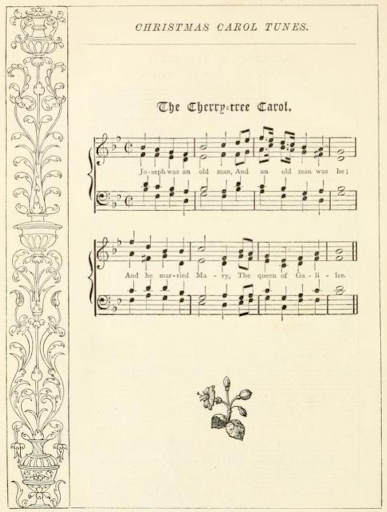
Cherry Tree Carol, The


The Cherry Tree Carol: Roud 453, NOBC 128; this is an old song and one of three ‘Doubting Joseph’ carols in the New Oxford Book of Carols. The other two are 'When Righteous Joseph wedded was' and 'O Joseph, being an aged man truly', neither of which involve cherries.1 All three carols are about Joseph’s dilemma when he finds out that his fiancée Mary is pregnant. Professor Child of Harvard University included The Cherry Tree Carol among his collection of ballads (no.54, 4 texts).2 The majority of his ballad texts date from the 17th or 18th centuries.
This very popular carol is still sung today, having been revived in the 1960s by Jean Ritchie and Joan Baez in America,3 and by Shirley Collins and A.L. Lloyd in the UK. In its basic 19th century form, this carol is a miracle story which begins with the jealousy and guilt of Joseph, who considers separating from Mary but is visited by a reassuring angel.4 As they journey to Bethlehem, Mary is hungry and asks Joseph to pick some cherries for her from a tree. When he is slow to act, the unborn baby Jesus commands the tree to bow down, so that Mary may pluck the fruit and eat. In some versions several verses are tacked on as a kind of ‘flash-forward’ whereby, as an infant on Mary’s knee, Jesus predicts his life and suffering ahead. Clearly the song underwent adaptations and borrowings during the ‘folk process’.
The back story for this lies in the apocryphal Gospel of Pseudo-Matthew where (in Chapter 20) Mary is accompanied by the infant Jesus on their flight to Egypt after his birth.5 In this first version of the story, the tree bearing fruit was a date-palm (rather than a cherry).
Unsurprisingly, the story then reappears in two medieval mystery plays6: firstly, in the 15th century as Play XV (‘The Nativity’) of the N-Town Plays,7 in a conversation about cherries:
Maria: Now my spowse, I pray yow to behold
How the cheryes growyn upon yon tre…(Now my spouse I pray you to behold
How the cherries grow on yon tree)Joseph: Ow! To plucke yow of these cherries it is a werk wylde…
(To pluck cherries is hard work)
Maria: now I thank it god, yis tre bowyth to me down
(thank God, this tree bows down to me)
and secondly in another N-Town mystery play (Play XII ‘Joseph’s Doubt’) where Joseph is angry:8
Joseph: I dred me sore I am betrayd
Sum other man thee had in honde… (hand)
Sey me, Mary – this child’s fadyr, ho is? (who is the father?)
There were no cherries, nor miracles in this second example, but the human story of Joseph’s jealousy clearly had popular appeal and early carols on this theme were then produced.9 Over time, pointed references to Joseph as ‘an old man’ also began to appear.10
So, by the 17th century we see two separate strands of broadsides – examples are:-11
a) ‘When Righteous Joseph wedded was: to the tune of ‘The Blazing Torch’: This was a ballad in the collection of Samuel Pepys, the diarist and it is dated c1686.
b) ‘Joseph an aged man truly’ was a ballad with 18 stanzas’.
Note: Both these carols were about Joseph’s doubts and neither involved cherries or miracles.
It was not until the early 19th century that cherries reappear in new songs in circulation, particularly by printers in the Birmingham area.12 It is therefore not surprising that when Cecil Sharp published two versions of 'The Cherry Tree Carol' in 1911, he had collected them not so far away – from Mrs Ellen Plumb of Armscote, nr Stratford-upon-Avon and Mrs Mary Ann Clayton, ten miles away in Chipping Campden.13
There are plenty of modern folk artists still singing this carol, re-discovering tunes for it. See Mainly Norfolk website.
Footnotes
1 The ‘Righteous Joseph’ carol is no.129 in the New Oxford Book of Carols; ‘Aged Joseph’ is no.130.
2 Child, Francis, The English and Scottish Popular Ballads in five volumes printed between 1882 and 1898. All 305 ballads and lyrics are online at the Internet Sacred Text Archive. Francis James Child (1825-96) was Professor of English at Harvard from 1867.
3 The song was carried to America by immigrants and Cecil Sharp collected 6 versions during his collecting trips in Kentucky and North Carolina in 1916-17. He published two of these in his book with Olive Dame Campbell English Folk Songs from the Southern Appalachians (New York: Putnams, 1917 pp43,44) online at Internet Archive.
4 Joseph’s doubts: St Matthew 1: 18-25.
5 The Gospel of Pseudo-Matthew is a late work, written in Latin in the 7th century; scroll http://gnosis.org/library/cac.htm for a modern translation. The escape to Egypt to avoid the wrath of King Herod is told in the Authorised Bible at Matthew 2:13, while Mary’s journey to Bethlehem to give birth is at Luke 2:4-6. Certain other early Apocryphal Gospels (of Thomas, of Judas) were already excluded from the Bible canon by the 5th century AD.
6 Mystery Plays were performed across medieval Europe from the 11th century onwards, presenting stories from the Bible to inform the largely illiterate people. The plays were initially led (in Latin) by clerics but were taken over by the craft guilds using vernacular language. They were performed either on fixed stages or on pageant wagons, particularly (after 1264) as part of the Corpus Christi processions sixty days after Easter.
7 Early scholars wrongly attributed this mystery text (from a manuscript donated by Sir Robert Cotton to the British Library) to the Coventry Play cycle, but modern scholars have proved the text belonged instead to the N-Town Plays of East Anglia. So, be careful which reference book you are consulting! Both William Hone, in his Ancient Mysteries book (1823 pp. 67-8) quoted the cherries extract as if from the Coventry Plays, and Cecil Sharp followed suit in his English Folk-Carols book (London: Novello p62). View the Medieval English Texts website, ‘N-Town Play 15’ lines 32ff.
Full discussion at https://www.digitalmedievalist.com/2010/12/24/the-cherry-tree-carol/
Note: The N-Town Plays were compiled and edited from a mass of religious material in the 15th century in East Anglia. The manuscripts are held at the British Library (BL MS Cotton Vespasian D.8). The book The N-Town Plays ed. Douglas Sugano (Kalamazoo: Medieval Institute Publications 2007) is online. ‘N’ stands for Latin ‘nomen’, meaning ‘name’. These plays were not bound to a specific town (like the Chester plays) but toured round East Anglia, so a town crier would simply insert the name of the new location of any performance.
8 The lines quoted from Play 12 are at the Medieval English Texts website: lines 27,28,36.
9 The American scholar Richard Leighton Greene in his book The Early English Carols (Oxford: Clarendon Press 1935) quotes three late medieval carol texts (15th, 16th century) nos. 258-260, pp184-185. Online at the Internet Archive.
10 The Bible doesn’t tell us Joseph’s age, only that he was a carpenter (Matthew 13:55). The Apocryphal Gospel of James said Joseph was a widower with children of his own. His ‘old age’ helped promote the catholic doctrine of the perpetual virginity of Mary.
11 The Righteous Joseph ms is held at Magdalene College, Oxford and is viewable online at the English Broadside Ballad Archive (EBBA) ref 32616 at the University of California Santa Barbara; the Aged Joseph carol is one of the Roxburghe ballads held at the British Library and is also online EBBA 30691 (date of printing 1678-1680).
12 Broadsides by T. Bloomer, printer of Birmingham (Bodleian Library, Oxford: Douce adds. 137 no.26, date 1817-1827) and by J. Russell, printer of 24 Moor St, Birmingham (Birmingham Library 60338: date c1816).
13 Sharp collected a total of 10 versions of the Cherry Tree carol in England: Mrs Clayton’s version is CJS2/10/2069 and Mrs Plumb’s CJS2/10/2586 at archives.vwml.org, published in his English Folk-Carols (London, Novello 1911 pp7-10). For profiles of Mrs Clayton and Mrs Plumb, go to https://cecilsharpspeople.org.uk